You have probably seen it already.
A small white creature with almost no face, sitting on a shelf in a MINISO.
A keychain in an anime shop. A plush that costs more than it should. If you asked what it was, someone told you it was Chiikawa, and that was the end of the conversation.
Here is the part nobody tells you.
The name itself promises nothing.
Chii is from chiisai, small. Kawa is kawaii, cute, cut short.
The full title of the series is Nanka Chiisakute Kawaii Yatsu — roughly, “some kind of small cute thing.” Not a name so much as a shrug.
In China, fans have taken to calling it digital ibuprofen.
Ibuprofen is a painkiller. That is not how people talk about cute things. That is how people talk about something they take when it hurts.
I want to explain why.
I am Japanese. I have taught at Japanese universities for a long time and I have worked as a counsellor for about forty years.
I did not come to Chiikawa as a fan. I came to it because my students kept talking about it, and because what they were describing did not sound like a cute animal at all.
Today, the film opened
I am writing this on 24 July 2026, the day Chiikawa: The Secret of Mermaid Island opened in Japanese cinemas.
It is the first film in the series.
The story is one that ran on X between March and November 2023, and Japanese fans have wanted it on a screen ever since.
As of today there is no announced English-language release, so if you are reading this outside Japan, you cannot see it yet.
That gap is roughly the point of this article. The merchandise crossed the border years ago. The story has not.
What it actually is
Chiikawa started as one drawing.
In September 2017 an illustrator called Nagano posted a small round creature on Twitter with a line saying, more or less, I want to live like this. Small. Cute. Untroubled.
A dedicated account opened in January 2020 and the comic became a daily thing. Then:
- December 2020 — the official online shop opens and the server crashes under the traffic
- April 2022 — an animated version starts airing inside a morning news programme on Fuji TV
- June 2022 — it wins the Japan Character Award, the first work born on Twitter ever to do so
- 2022 — its merchandise ranks second in Nikkei Trendy’s products of the year
- 2024 — it wins the Japan Character Award again
- November 2025 — the manga passes 4.6 million copies
Four and a half million followers. Two national awards.
A product director at Kiddy Land, one of Tokyo’s biggest toy stores, said he had spent thirty years in the business and had never seen a character behave like this.
None of that explains the painkiller.
There is a job, and there is an exam
Here is what happens in the story.
The characters work. They go out on discovery — hunting unidentified creatures for pay.
It is dangerous. People get hurt. The money is not good.
And there is a qualification system. There is an exam called the weeding certification. Pass it and you get better work.
Chiikawa, the main character, sat the fifth-grade exam. Failed. Sat it again. Failed again. By volume two of the manga, that is where things stood: two attempts, two failures.
Chiikawa finally passed on the third attempt, in a strip Nagano posted on 3 July 2025.
Eight years after the character first appeared. Five years into the serialisation.
Think about what that means as a piece of storytelling.
The author let the protagonist fail a low-level qualification exam for half a decade of real time, in public, in front of four million people, and then let him pass without fanfare.
That is not a children’s story. That is a description of a working life.
What my students taught me about this
There is a question I have been asked by students every single year.
“If I get qualifications, will it help me get hired?”
The students who ask it usually do not understand how qualifications work.
They go wide. They sign up for several, pay the fees, study hard, and collect certificates. It is genuinely admirable effort.
But there is a condition attached to whether it helps.
It is not about holding many certificates at high grades. It is about holding a few, chosen deliberately.
If you have the money and the ability to spare, by all means collect high grades in quantity.
Just understand that whether any of it translates into something usable at work is not your call. That judgement belongs to the people hiring you.
A qualification does not speak for itself.
This matters more in Japan than it might where you are.
Japanese hiring for new graduates happens in one synchronised cycle, everyone applying at the same time in their final year, competing against people with identical degrees.
Under that pressure, students reach for anything that looks like a differentiator. Certificates are cheap to acquire and easy to list. So they acquire them.
The serious students are the ones who suffer most. The harder somebody is trying, the more directions they spread themselves in.
Every time I read a strip where Chiikawa sits that exam again, I think about them.
The direction of the projection is backwards
Normally, attachment to a character runs upward.
You admire something you are not. Stronger, smarter, braver, better looking. The character is a version of who you would like to become.
Chiikawa runs the other way.
The main character is timid. He cries easily.
He is not especially capable. His friend Hachiware is optimistic and articulate; his friend Usagi is chaotic and effectively invincible. Chiikawa is the one who is frightened and goes to work anyway.
Readers do not look up at him. They look across.
And he never asks anything of them. He does not lecture.
He does not tell anyone to try harder. He is simply having the same trouble they are, at the same time, every morning, for free, in their timeline.
I will put this in the plainest professional terms I can.
What people in distress most often need is not a solution. It is evidence that they are not the only one. That is close to the first thing you learn in this work.
That is where the painkiller comparison comes from.
Then it crossed the border
Everything above can be explained as a Japanese story about Japanese work culture.
Discovery is the job you cannot quit. The weeding exam is the certificate that does not save you. Fine.
The problem with that explanation is what happened next.
Official merchandise went international in March 2024.
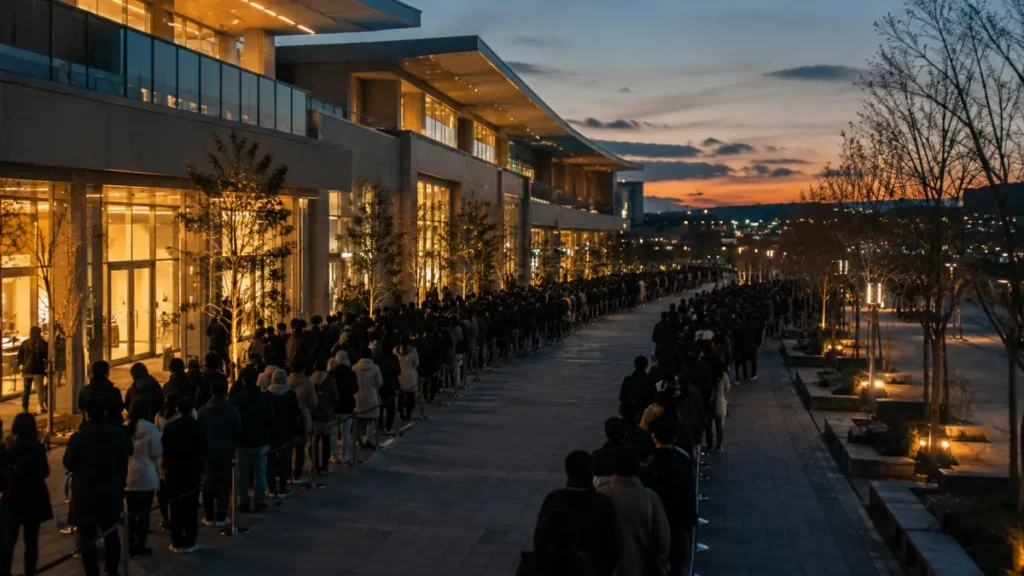
China went first. The first licensed pop-up shop opened in Shanghai at the end of that month and took roughly 8 million yuan — over a million US dollars — in three days.
The queue reached about seven thousand people and local police broke up the crowd.
It spread to Beijing, Hong Kong, Taiwan, Malaysia and South Korea, then to pop-ups in New York and Las Vegas.
In 2024 Chiikawa entered China’s top ten intellectual properties by sales, and was honoured at MINISO’s Super IP Awards alongside Harry Potter and Disney.
This autumn, international toy distribution begins in earnest through a partnership with Jazwares.
So the monsters and the weeding exam — invented, as far as anyone can tell, as a way of drawing Japanese working life — are landing in Shanghai, Seoul, and New York.
Japanese cultural exports are usually explained by their Japaneseness. Chiikawa suggests something less flattering and more interesting.
The exhaustion may not have been ours alone.
I am not sure that is comforting. It is what the evidence says.
Where to start
Three characters, if you are new:
- Chiikawa — the protagonist. Frightened, tearful, and never once runs
- Hachiware — his best friend. Optimistic and good with words. His optimism does not come from having an easier life
- Usagi — chaotic, powerful, largely non-verbal. Exists to break the story open
The manga is free.
Nagano still posts it on X, almost daily, in Japanese.
You will not understand the words at first. You will understand what is happening in the panels sooner than you expect — that is part of why it travels.
The film is in Japanese cinemas now. Whether it reaches you, I cannot say.
Related article
Chiikawa the Movie Is Already Playing Across Asia. So Where’s Everyone Else?
The Chiikawa movie is rolling out across Asia while the West waits. Here’s exactly where it stands, what you can watch right now, and why the wait happens.
Taiwan, Hong Kong, Korea — the Chiikawa movie keeps opening across Asia. So why is the West still waiting, and what can you watch in the meantime? An honest status check.
Official links
- Chiikawa: The Secret of Mermaid Island — official film site (Japanese)
- Chiikawa Info — official hub for events, shops and collaborations (Japanese)
- Chiikawa Market — official goods shop, and the best place to see the range
- Chiikawa Land — permanent store locations (Japanese)
- Nagano’s Chiikawa account on X — where the comic is actually published
- Chiikawa Land on X — new product photographs, posted constantly
Read Next
If you have seen the plush toys hanging from bags in Japan, I have written about what that is elsewhere.
Japan Has Hotels That Take Bookings for Stuffed Animals

Japan Spends $27 Billion a Year on People Who Don’t Know They Exist
This is part of a series on what’s currently happening in Japan, and why.