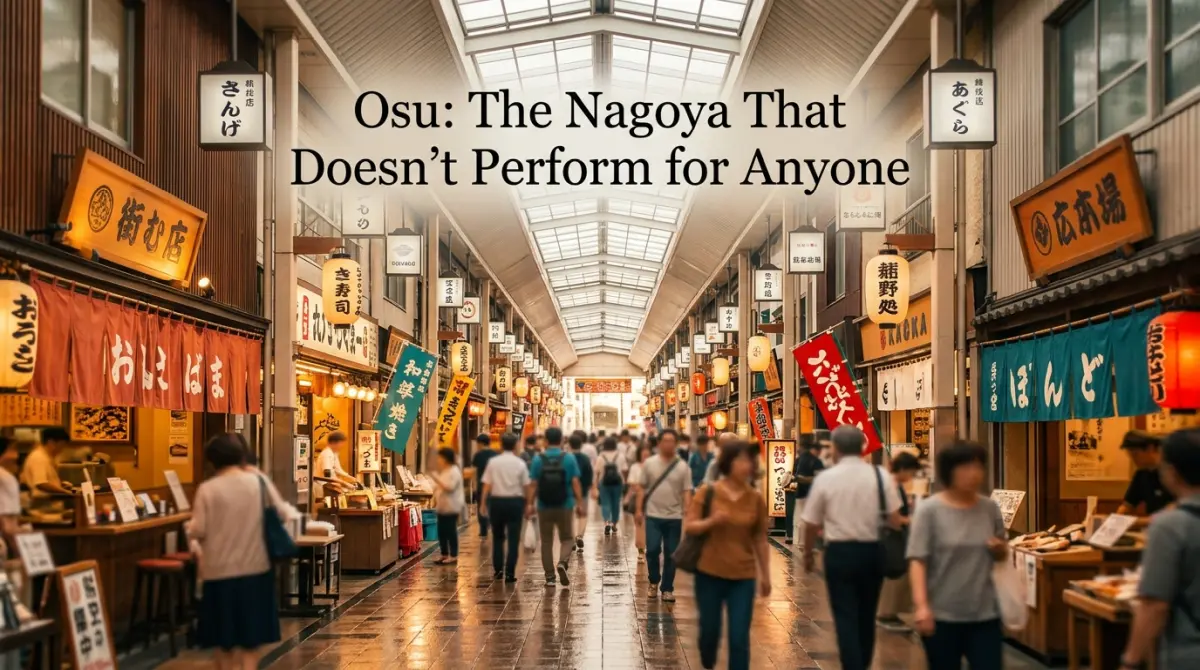
You’ve done the castle, the shrine, the museums — the sights a city puts out for visitors. Osu is where you meet the city itself. It isn’t a monument or an attraction; it’s a neighborhood, a tangle of covered arcades packed with more than a thousand shops, a four-hundred-year-old temple, vintage clothing racks, cosplayers, and the smell of frying chicken, all layered on top of one another.
And it’s mostly locals. If the rest of Nagoya keeps its best parts one layer down, Osu is where the layer comes off — the clearest place in the city to see that “nothing here” was never true.
A Temple Town That Grew Into a Beautiful Mess
Osu began as the town in front of Osu Kannon, a Buddhist temple with a striking red main hall that still anchors one end of the arcades.
Over the centuries the streets around it filled in — first with theatres and music, then secondhand markets and electronics, then fashion and subculture — until the place became what one visitor perfectly called a mix of Akihabara, Harajuku, and a flea market poured into the same few blocks.
A short walk takes you past an incense-clouded temple, a maid café, a rack of 1980s band tees, and a stall selling Turkish kebabs, and nobody finds the combination strange. That refusal to tidy itself into a single theme is exactly the appeal.
Duck into Banshoji, another temple tucked right into the shopping street, with ties to the warlords who shaped early Nagoya and a mechanical dragon that performs a short light-and-water show every couple of hours — a very Osu collision of the sacred and the theatrical.
Eat While You Walk
Osu is one of the few places in Nagoya where tabearuki — eating while you walk — is not just tolerated but encouraged, and the food leans gleefully international. Taiwanese fried chicken, takoyaki, crepes stuffed and folded to order, mitarashi dango, Brazilian and Peruvian snacks, kebabs, even “meat sushi.”
The district has long been one of Nagoya’s true melting pots, and the easiest way to taste that is simply to graze your way from one end of the arcade to the other. Follow the queues; the locals know.
Vintage, Electronics, and the Cosplay Capital
For hunting rather than eating, Osu rewards the patient. The big reuse department store KOMEHYO and dozens of secondhand shops make it a genuine treasure-hunt for vintage clothing and watches, with the better finds usually hiding in the side streets rather than the main drag.
Toward Akamon Dori the mood shifts to electronics and otaku culture — PC parts, figures, anime shops, maid cafés — and the whole district is the main stage for the World Cosplay Summit, so costumed regulars are simply part of the scenery, not a spectacle laid on for you.
Near the Fureai Hiroba plaza, look for the neighborhood’s beloved giant maneki-neko, the Osu lucky cat.
Why This Is the Real Nagoya
Here’s what I’d want a first-time visitor to notice. Osu is often compared to Osaka’s Dotonbori, but it’s smaller, calmer, and far less tourist-heavy — and that’s not a shortcoming, it’s the whole character. Dotonbori performs. Osu doesn’t.
It’s a place a city goes to be itself: unpretentious, multicultural, a little chaotic, quietly delighted by its own jumble. Spend a Sunday afternoon here and you feel something the monuments can’t tell you — that the people who supposedly think their city is boring have built, and clearly love, one of the most alive neighborhoods in central Japan. The affection Nagoya won’t say out loud is written all over these streets.
Practical Notes
Osu is in central Nagoya, easiest reached on the subway Tsurumai Line at Osu Kannon or Kamimaezu Station, and it’s only about ten minutes from Sakae. The arcades are covered, which makes it one of the best rainy-day options in the city.
There’s nothing to buy a ticket for — you just wander — so give yourself a couple of unhurried hours to drift. If your timing is lucky, catch a festival: the big Osu Summer Festival in early August, or the smaller Akamon festival held on the 28th of each month, both good excuses to see the neighborhood at full volume.
Come hungry, and pair it with the city’s signature dishes while you’re at it. [cross-linkWhat Is Nagoya-meshi? The Bold Food Culture Kansai Can't Give You]

So this is where the tour of a “city with nothing” ends: in a crowded arcade that smells of kebabs and incense, where a lucky cat watches over vintage racks and cosplayers drift past a red temple gate.
Nagoya will never brag about Osu. It doesn’t have to. Stand here for an afternoon and the city finally stops underselling itself — because a place this warm and this alive can’t pretend to be nothing, no matter how modest it insists on being. That, in the end, is the whole reason not to skip it.
Nagoya Castle: The Honest Truth (the Keep Is Closed — Go Anyway)