Every day, tens of thousands of travelers pass through Takatsuki without noticing. It sits almost exactly halfway between Osaka and Kyoto — about fifteen minutes to either by rapid train — so to most visitors it’s a name that slides by the window on the way to somewhere famous. Nobody gets off.
They should. Because in this “somewhere in between” town you can climb onto the burial mound of an ancient emperor, touch reconstructed clay figures older ideas than most castles, hike a river gorge, and stumble into one of Japan’s biggest street music festivals.
And there’s a quieter reason Takatsuki is worth your attention: among Japanese people themselves, it consistently ranks near the very top of the places they’d actually want to live. That’s a different, and often more reliable, signal than any tourist ranking.
This is the Osaka most travelers never even slow down for.
- Walk on an emperor’s tomb — Imashirozuka Kofun
- A river gorge fifteen minutes from the fast train — Settsukyo
- The whole town becomes a stage — Takatsuki Jazz Street
- A Kyoto-style temple without the Kyoto crowds — Kabusan-ji
- The everyday Kansai you don’t get as a tourist — Anma Site Park
- A surprising thread: Takatsuki’s Christian lord
- Why locals actually want to live here
- What to eat
- Getting there
- The town worth getting off for
Walk on an emperor’s tomb — Imashirozuka Kofun
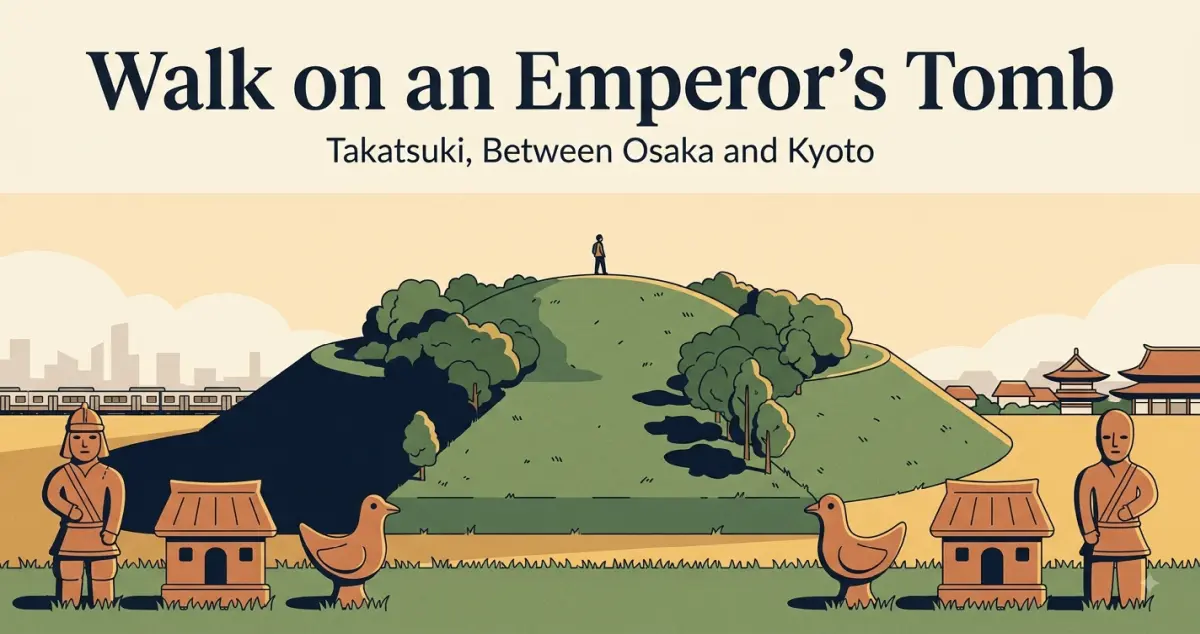
Start with the one that genuinely stops people. Imashirozuka Kofun is a keyhole-shaped burial mound, the largest of its kind in the Yodo River basin — the mound alone runs 181 meters, and with its double moat the whole site stretches roughly 350 meters across.
It’s believed to be the tomb of Emperor Keitai, who reigned in the early 6th century and was, by tradition, the great-grandfather of Prince Shōtoku.
Here’s what makes it extraordinary rather than just old. Almost every imperial-class tomb in Japan is sealed off — managed by the Imperial Household Agency, ringed by a fence, viewable only from a respectful distance.
Imashirozuka is, by the city’s account, the one place in the country where you can freely walk up onto and all the way around a great king’s tomb.
It’s been turned into a public park, and on any given afternoon you’ll find locals jogging its slopes, walking dogs, and picnicking on a monument that’s fifteen centuries old.
Beside the mound, the reconstructed haniwa ritual site lays out around 190 clay figures — houses, warriors, sumo wrestlers, shrine maidens, birds — recreating how the burial ground looked when it was built, and some of them you’re allowed to touch.
The adjacent Imashirozuka Ancient History Museum fills in the story, runs make-your-own haniwa and magatama bead workshops, and is presided over by Hanitan, the city’s cheerfully round haniwa mascot, who you’ll spot on everything from manhole covers to bus signs.
Access: JR Settsu-Tonda Station on the JR Kyoto Line, then a city bus toward Nasahara (get off at Imashirozuka Kofun-mae), or about a 30-minute walk. The park is free.
📍 Imashirozuka Kofun (JR Settsu-Tonda Stn) — Google MapsHere’s the odd part: the Imperial Household Agency doesn’t manage this one. It officially designates a different mound — Ota-Chausuyama Kofun in nearby Ibaraki — as Emperor Keitai’s tomb.
But archaeologists are fairly confident Imashirozuka is the real one.
Because it was never officially designated, it never got sealed off like every other imperial tomb in Japan. You can walk right up onto the mound. As far as anyone can tell, it’s the only one you can do that at.
A river gorge fifteen minutes from the fast train — Settsukyo
You don’t expect real wilderness this close to a station where limited express trains stop, but Settsukyo delivers it. It’s a wooded gorge along the Akutagawa river — 42 hectares of hillside with hiking trails, strange looming rock formations with names like Gyōja-iwa and Hachijō-iwa, small waterfalls, and a proper climb to a lookout if you want one.
It changes completely with the seasons: about 3,000 cherry trees and paper lanterns lighting the night blossoms in spring, children splashing in the shallows in summer, and deep red foliage in autumn.
There’s even a hot-spring inn tucked into the middle of the valley, so you can end a hike in an outdoor bath. It’s the kind of half-day of nature people travel hours for in Kyoto, sitting right behind a commuter town.
📍 Settsukyo Gorge (Takatsuki) — Google MapsThe whole town becomes a stage — Takatsuki Jazz Street
Once a year, over Golden Week, Takatsuki turns into one of Japan’s largest amateur music festivals. Stages pop up across the city — in halls, on station plazas, outside shops and shrines — and thousands of musicians play, most of it free to wander between. It’s less a polished commercial event than a town-wide outpouring, and it tells you something about the place: this is a community that shows up. That energy, more than any single sight, is what a lot of visitors remember.
Festival dates and program change each year — check the official schedule before planning around it.
Takatsuki Jazz Street takes place across the whole city over Golden Week. 📍 See the central area on Google Maps — for dates, stages, and the full lineup, check the official festival site.
A Kyoto-style temple without the Kyoto crowds — Kabusan-ji
If you love the mountain temples of Kyoto but not the crush of people photographing them, Takatsuki has an answer. Kabusan-ji was founded in 679 and is known as Japan’s first temple dedicated to Bishamonten, the guardian deity — more than 1,300 years of history on a quiet forested slope. In autumn its grounds turn brilliant with maples, and you can often have the view largely to yourself, fifteen minutes by train from a city where you’d be shoulder to shoulder for the same thing.
📍 Kabusan-ji Temple (Takatsuki) — Google Maps
The everyday Kansai you don’t get as a tourist — Anma Site Park
Not everything here is a “sight,” and that’s the point of the next stop. Anma Site Park is a big, modern park built on a Yayoi-period archaeological site: wide lawns, a café, families, kids running loose on a weekend. It isn’t spectacular, and it isn’t trying to be. It’s what daily life looks like in a town people choose — and it’s the natural bridge to the real question about Takatsuki.
📍 Anma Site Park (Takatsuki) — Google Maps
A surprising thread: Takatsuki’s Christian lord
One more layer worth knowing. Takatsuki Castle Park marks the old castle grounds, and the town’s most famous lord was Takayama Ukon — a daimyō who converted to Christianity in the 16th century and eventually gave up his lands and title rather than renounce his faith, dying in exile. It’s an unexpected strand of history for a town most people file under “commuter suburb,” and a quietly moving one.
📍 Takatsuki Castle Park (Takatsuki) — Google Maps
Why locals actually want to live here
This is the payoff the main Osaka list hinted at. Takatsuki keeps landing near the top of “where would you want to live” surveys in Japan, and once you’ve spent a day here the reason is obvious. It’s fifteen minutes by rapid train to central Osaka and fifteen the other way to Kyoto — you could work in one great city and spend your weekends in the other. It has a genuine river gorge, ancient tombs and temples, a fierce little cultural life, and the ordinary comforts of a mid-sized Japanese city, all without the rent or the crowds of either neighbor.
Takatsuki isn’t hype — the numbers back it up. In Yomiko’s first-ever nationwide Civic Pride survey (announced January 2026), Takatsuki ranked 3rd out of 278 cities across Japan, and 1st in the Kansai region. Separately, Daito Kentaku’s “Ii Heya Net” survey has ranked Takatsuki Station 3rd in Osaka Prefecture’s “want to live here” rankings for four years running (2023–2026).

Tourist rankings tell you where people want to go. This one tells you where they want to stay. For a traveler, that’s a tip worth acting on: Takatsuki is the version of Kansai that locals keep for themselves.
What to eat
Because you won’t find these by rushing through: Takatsuki is known for shirako-takenoko, tender white bamboo shoots with a natural sweetness; sanga-maki tomatoes prized for their high sugar in early spring; and Hattori shirouri, a traditional Naniwa gourd grown in the area for generations. Local, seasonal, and exactly the sort of thing you only meet if you get off the train.
Getting there
Takatsuki sits on the JR Kyoto Line, with rapid and special-rapid trains stopping roughly midway between Osaka and Kyoto (about 15 minutes to each). The Hankyu Kyoto Line also runs through, stopping at Takatsuki-shi Station. It works beautifully as a half-day detour from either city, or as a base for seeing both.
The town worth getting off for
Everyone rushes past Takatsuki on the way between two famous cities. Get off, and you can walk on an emperor’s tomb, touch the clay figures that guarded it, hike a gorge, and see the unglamorous, genuinely good daily life that Japanese people rank among the best in the country. Of all the “wait — that’s near Osaka?” surprises in this series, the town nobody stops in might be the biggest one.
Takatsuki was the bonus stop in Wait, That’s in Osaka? — 7 Places That Break the Image. If you’re building an Osaka trip, pair it with the following articles.