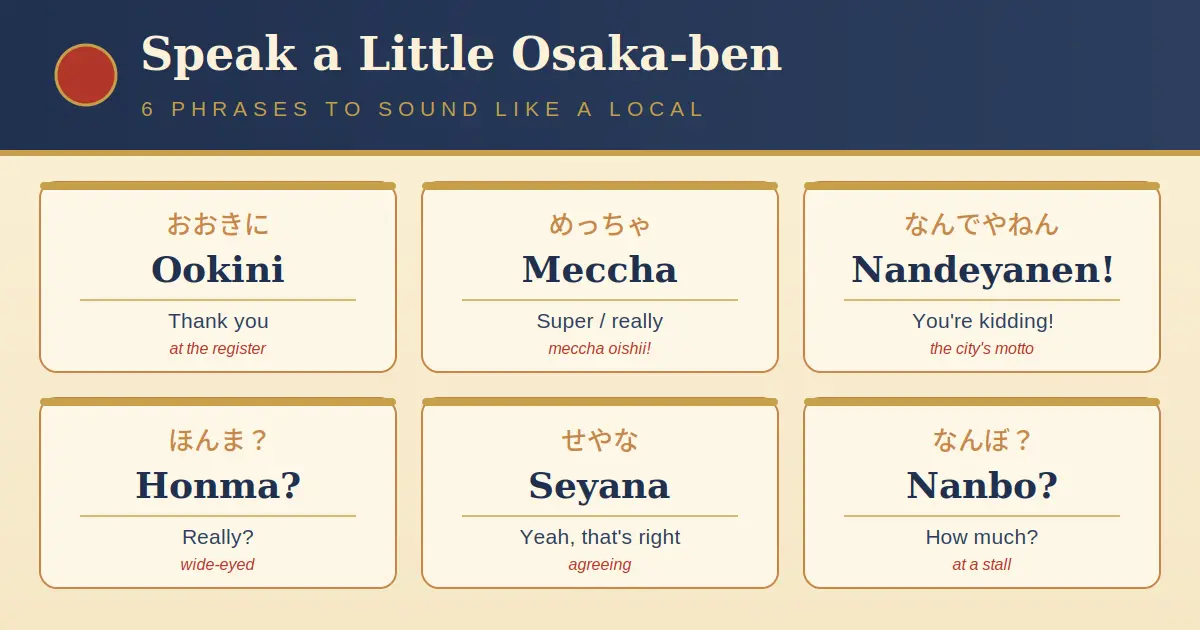
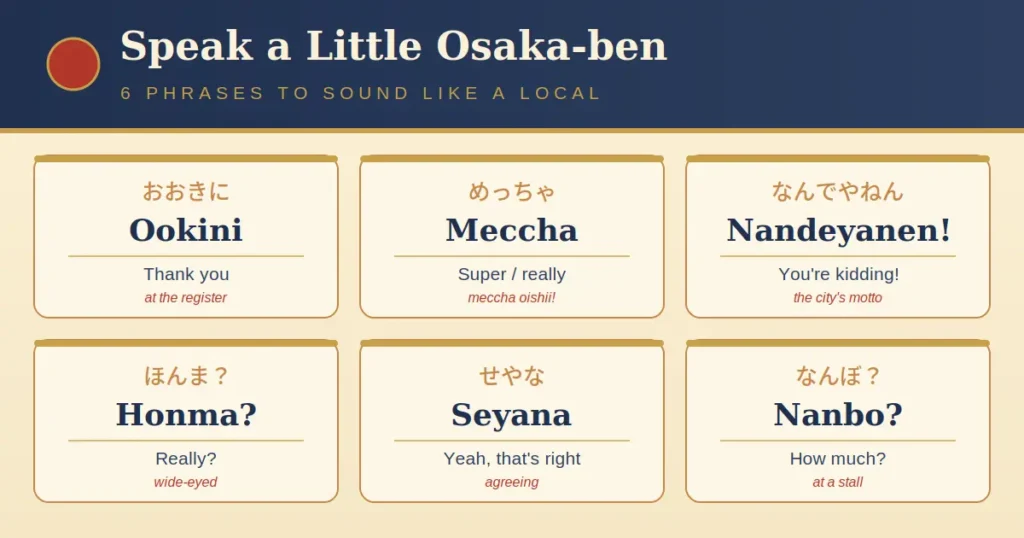
Of everything you can pack for Osaka, the most useful thing weighs nothing: a few words of the local dialect. Osaka has its own way of talking, Osaka-ben, and it carries a warmth and humor that even other Japanese find disarming. You don’t need to be fluent. Throw one or two of these phrases at a shopkeeper or an izakaya owner at the right moment, and you’ll watch a polite transaction turn into an actual conversation.
This is the companion to our seven surprising places in Osaka — because the thing people remember most about the city isn’t a place at all. It’s how the people talk to you.
Why Osaka talks differently
Standard Japanese — the kind in textbooks — is modeled on Tokyo speech. Osaka never went along with it. The dialect here is faster, more musical, and built for banter. Osaka is the home of manzai, Japan’s fast double-act comedy, and that rhythm soaks into everyday life: people set up jokes and knock them down, tease strangers gently, and treat a quick, funny reply as a small social victory.
What this means for you as a visitor is simple and lovely: an attempt counts for a lot. Nobody expects a tourist to speak Osaka-ben, so even a clumsy “ookini” lands as a gift rather than a test. You’re not being graded. You’re being welcomed.
Thanks and hellos
Ookini — Thank you. The single most valuable word in this whole guide. It replaces the standard arigatō, and locals grin every time a visitor uses it. Say it when you pay, when you’re handed something, when you leave a shop.
🔊 Listen Ookini 👇
Maido — roughly “Thanks / hey there.” You’ll hear shopkeepers say it as you walk in — it started as “thanks for your business” and became an all-purpose greeting. Echo it back and you’ve instantly read the room.
🔊 Listen Maido 👇
Reactions that make you sound local
Honma? — “Really?” (standard: hontō?). The everyday reaction to anything surprising. “Honma?!” with wide eyes works in almost any conversation.
Meccha — “super / really” (standard: totemo). Stick it in front of anything: meccha oishii (super tasty), meccha ee (really good), meccha omoroi (really funny). This one word will do a lot of heavy lifting.
🔊 Listen Meccha omoroi👇
Omoroi — “funny / interesting” (standard: omoshiroi). In a city that prizes being entertaining, calling something omoroi is high praise.
The famous one
Nandeyanen! — somewhere between “What the—?!” and “You’ve gotta be kidding me!” This is the classic tsukkomi, the retort half of a manzai comedy duo, and it’s practically Osaka’s unofficial motto. It’s used with a laugh, never real anger — a mock-exasperated reply to something silly. Land it at the right moment and you’ll get a delighted reaction, because you’ve just spoken the city’s native comedic language.
🔊 Listen Nandeyanen! 👇
Yes, no, and “it’s fine”
Seya / Seyana — “Yeah, that’s right” (standard: sō da / sō da ne). Your go-to agreement.
🔊 Listen Seyana 👇
Chau — “No / that’s not it” (standard: chigau). Doubled up as chau chau, it’s an affectionate “no no, that’s not what I meant.”
🔊 Listen Chau 👇
Akan — “No good / you can’t do that.” Covers everything from “that’s not allowed” to “oh no.” A tiny word that does big work.
Ee de — “It’s fine, go ahead.” (Ee is the Osaka ii, “good.”) A relaxed green light.
For shopping and eating
Nanbo? — “How much?” (standard: ikura?). Handy in markets like Kuromon or Shinsekai’s stalls.
🔊 Listen Nanbo 👇
And a bit of local flavor you probably won’t need but should know, because it tells you exactly who Osaka is: the old merchant greeting Moukarimakka? — “Making any money?” — traditionally answered with Bochibochi denna — “Ah, getting by.” A whole city’s character in one exchange: money, humor, and modesty, all at once.
🔊 Listen Moukarimakka? 👇
🔊 Listen Bochibochi dennna 👇
Two tiny grammar tricks
You’ll recognize Osaka-ben faster if you spot these:
- -hen replaces the standard negative -nai. Wakaranai (I don’t understand) becomes wakarahen. Ikanai (I won’t go) becomes ikahen.
- -ya replaces the plain da (“is”). Sō da becomes sō ya; nan da becomes nan ya.
🔊 Listen Wakarahen 👇
🔊 Listen ikahen 👇
You don’t have to produce these — just knowing them turns background chatter into something you can follow.
One “false friend” to save you confusion
If an Osaka local tells you to naosu your bag, they don’t want you to repair it. In Kansai, naosu also means “to put away.” “Naoshite” here usually means “tidy it up / put it back,” not “fix it.” Harmless, but it trips up learners every time.
How to actually use them
The goal isn’t to perform. It’s to be warm. A few tips:
- Aim these at shopkeepers, stall owners, izakaya staff — people whose whole day is small exchanges. That’s where Osaka-ben lands best.
- Say it with a smile and don’t overdo it. One well-placed ookini beats a rehearsed speech.
- Don’t stress about the melody. Osaka-ben has a different pitch and rhythm from Tokyo Japanese, and you won’t nail it — nobody expects you to. The attempt is the whole point.
The best souvenir is a conversation
You’ll remember the food and the neon. But the moment that tends to stick is smaller: the takoyaki seller who lit up when you said meccha oishii, the shop owner who laughed at your nandeyanen. Osaka’s real attraction was never just the places on the list — it’s the people, and a handful of these words is the fastest way in.
More Osaka Most Travelers Never See (Related Articles)