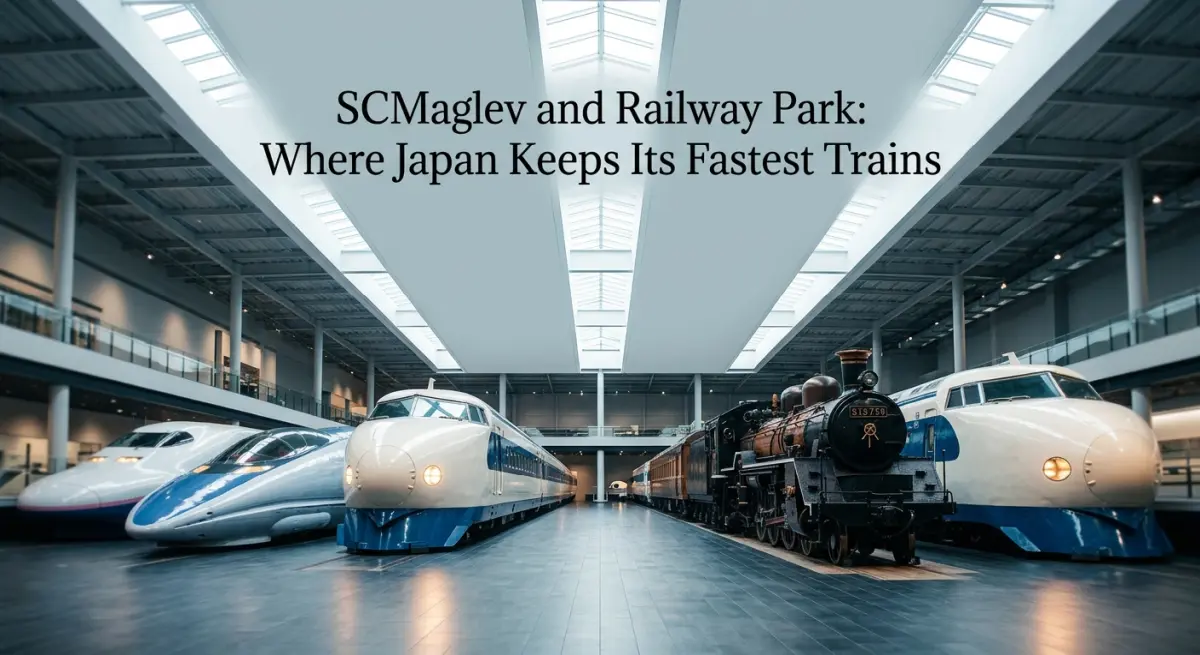
Japan didn’t just build good trains — it twice changed what a train could be. The 1964 Shinkansen showed the world that high-speed rail was possible; the superconducting maglev is poised to do it again. This museum, run by JR Central at the edge of Nagoya, is the one place you can stand right next to the physical proof, record-breakers included.
And you don’t have to be a train person to feel it — you just have to be a little curious about why Japanese trains are a global legend.
The Three Trains at the Door Tell the Whole Story
Walk in and you’re met by three machines lined up side by side: a C62 steam locomotive, an experimental Shinkansen that set a speed record in its testing days, and an MLX01 superconducting maglev. That’s the entire arc of Japanese rail in a single glance — steam, to bullet train, to levitation.
A point of accuracy, since it gets muddled online: the MLX01 on display was a world-record holder in its era, but the current record for the fastest train on Earth — 603 km/h (375 mph) — belongs to its successor, the L0 series, set in 2015. Either way, you’re standing in the lineage that holds the record, which is not something you can do anywhere else.
Walk Through Every Shinkansen Ever Built
The main hall holds 39 real train cars, and most of them you can climb inside. You’ll find every generation of Shinkansen, from the round-nosed Series 0 — the 1964 original that launched high-speed rail worldwide — through to the modern N700. Around them sit steam locomotives, vintage limited-express carriages, and old luxury dining cars with the tables still set, menus and dinnerware in place. It’s a rare museum where the exhibits are things you can board rather than admire from behind a rope.
The Fun Part: Simulators, a Maglev Ride, and Japan’s Biggest Diorama
This is where it wins over kids and skeptics alike. The star is the N700 Shinkansen driving simulator — a life-size cabin where you drive the Tokyo–Nagoya run with real scenery rolling past.
There are also conventional-train and train-conductor simulators (the conductor one puts you in charge of opening and closing the doors). They carry a small extra fee and are allocated first-come or by lottery at the information desk, so sort that out when you arrive.
In the Superconducting Maglev section, a dynamic mini-theater simulates riding the coming maglev line at 500 km/h using sound, vibration, and screens — the closest you’ll get to the future train until it actually opens.
And the Great Diorama is one of the largest model railways in Japan: a 1/80 recreation of the Tokyo-to-Osaka corridor themed “a day in the life of the railway,” with the lighting shifting from day to night. One quirky touch: the on-site shop sells train-themed bento boxes you can eat inside a real N700 car parked outdoors.
Worth It Even If You’re Not a Railfan
Strip away the trainspotting and what’s left is a genuinely good story: how one country made the train its national masterpiece, obsessively, for sixty years and counting. Even visitors who arrive indifferent tend to get it once they’re standing under a record-breaker.
And it connects to your own trip in a way most museums can’t — the Nagoya you arrived in is set to be a terminus of the future maglev line, so this isn’t just history under glass; it’s a preview of the journey you’ll one day take.
Practical Notes
Getting there is part of the fun: from Nagoya Station, take the Aonami Line to the end of the line at Kinjofuto Station — about 24 minutes, ¥360, and the museum is a two-minute walk. Note the Aonami Line is not covered by the Japan Rail Pass, so you’ll pay the fare separately.
Admission is around ¥1,200 for adults, with the simulators charged separately (roughly ¥100–¥500 per session, booked at the information desk).
A free English audio guide runs on the museum Wi-Fi. Because hours, fees, and the simulator booking system can change — and the museum closes one day a week — confirm the current details first: SCMaglev and Railway Park official site (English). Give it at least two hours.
Two ways to make a day of it: pair it with the Toyota Commemorative Museum across town for a proper technology day [cross-link The Toyota Commemorative Museum: Toyota Didn't Start With Cars], or, if you’re travelling with children, note that Legoland Japan and the Port of Nagoya aquarium are right in the same district.
Think about where the world’s proudest rail engineering ends up: parked quietly at the last stop of a local line, in a city everyone skips.
No fanfare, no queue around the block — just the record-breakers, waiting for whoever bothers to ride out and see them. And here’s the fitting part: the skipped city is exactly where the country’s next great leap, the maglev line, is meant to stop. Nagoya has a way of holding the future without mentioning it.
Nagoya Castle: The Honest Truth (the Keep Is Closed — Go Anyway)