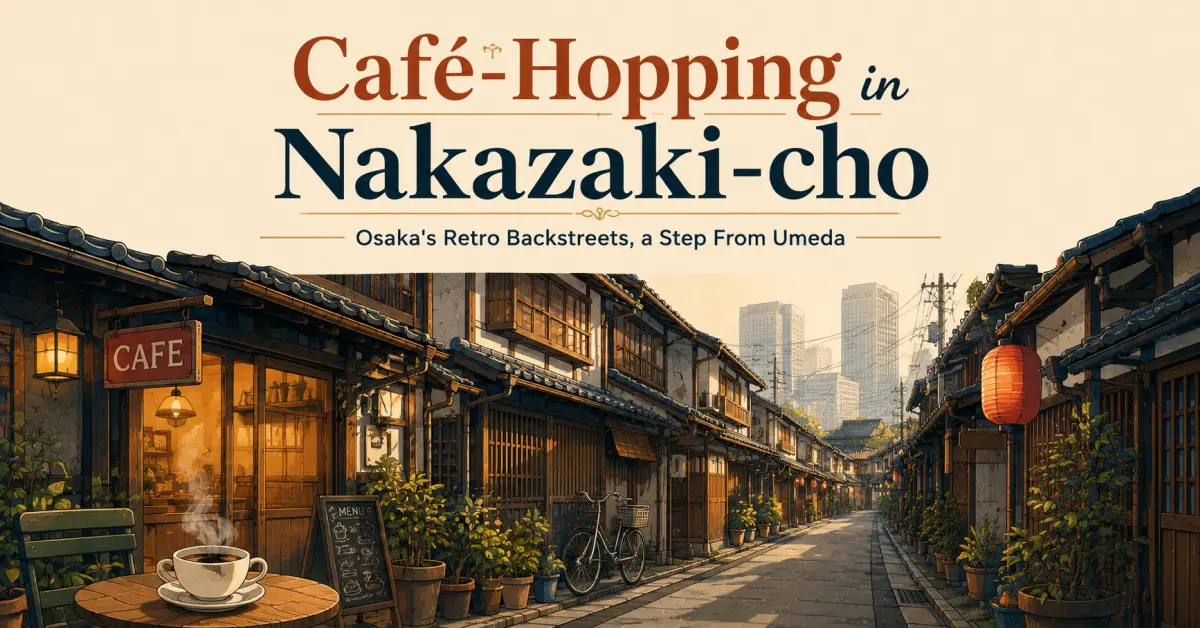
In our list of seven places that break the image of Osaka, this one was number one. It’s also the easiest to reach. Walk about ten minutes north from the department stores and neon of Umeda, and the wide avenues start to narrow.
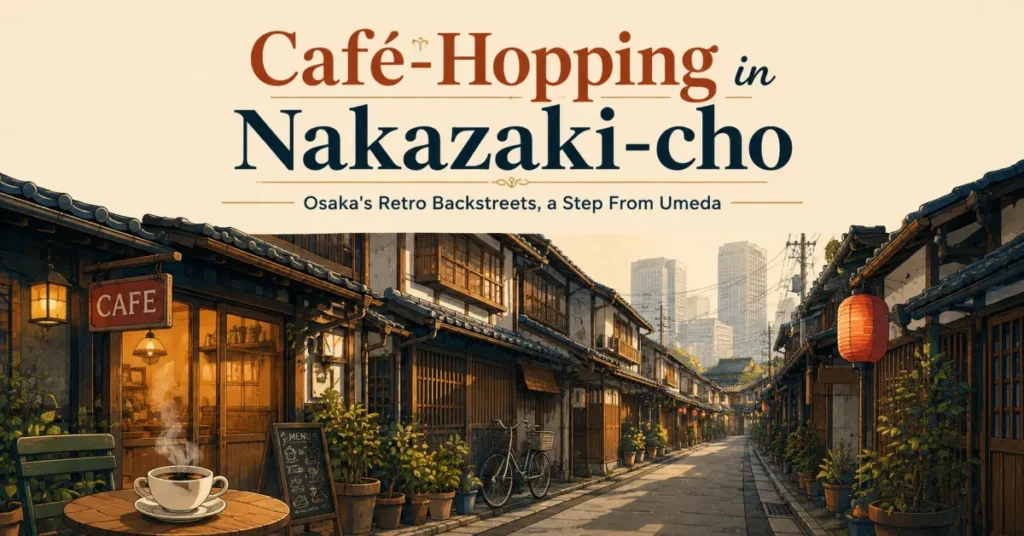
The glass towers give way to two-story wooden houses with potted plants crowding the doorways, the lanes shrink to barely a car’s width, and the noise just… drops. This is Nakazaki-cho, and it’s the closest thing central Osaka has to a slow morning.
Why it looks nothing like the rest of the city
Most of central Osaka burned in the war and came back in concrete. Nakazaki-cho mostly escaped both the bombing and the postwar redevelopment that redrew the neighborhoods around it, so its prewar nagaya — long, low wooden row houses — are still standing. For decades it was simply an aging residential pocket a stone’s throw from the busiest station in western Japan.
Then, from the early 2000s, young owners and artists began moving into the empty houses and opening cafés, vintage shops, and one-room galleries.
Today locals call it Osaka’s “art and fashion” quarter, though it wears the label lightly. On the same narrow street you’ll pass a grandmother watering her plants, a student photographing a doorway, and a café owner chalking up the day’s cake.
How to get there, and when to go
Nakazakicho Station (Osaka Metro Tanimachi Line), one stop from Higashi-Umeda, Exit 2. Or just walk north from Umeda / Osaka Station — it’s 10 to 15 minutes on foot.
📍 Nakazakicho Station (Osaka Metro Tanimachi Line) — Google Maps
Go on a weekday, mid-morning if you can. Many of the cafés and shops are one-person operations: they open late morning, close in the early evening, and take their days off midweek as often as on weekends. That makes Nakazaki-cho a poor place to plan and a wonderful place to wander. Come with an empty stomach, too — Osaka runs on a strong “morning set” café culture, where a coffee quietly comes with toast and an egg.
Start where the coffee started
The district’s café culture has a clear origin point, and it happens to be the perfect place to begin. cafe 太陽ノ塔 (Taiyō no Tō) opened in 2002 and is widely credited as the first of the Nakazaki-cho cafés. Inside it’s full-blown Showa kissaten: antique chairs, warm low light, hearty “café-meshi” plates like omurice, a glass case of cakes, and shelves of prettily illustrated cookie tins to take home. There are a couple of branches within a short walk of each other.
Here’s the wink. The café shares its name — same sound, same meaning, Tower of the Sun — with the Expo ’70 monument from our main list. There’s no connection between the two; it’s just a happy coincidence that the café named after Osaka’s most surreal landmark is the one that kicked off this entire quarter.
🔗 Official site: taiyounotou.com
Then just wander
The real pleasure here isn’t a checklist. It’s turning down a lane because a doorway looked interesting and finding a café that seats eight people. Nearly every place is a single converted room, shaped entirely by whoever runs it — one is all secondhand furniture and sunlight, the next is dark and full of records. You don’t visit Nakazaki-cho so much as drift through it.
A couple of reliable anchors to orient your drifting: green pepe, a shop-café stuffed with vintage clothing and retro Showa glassware, is a long-runner (closed Tuesdays); and several kominka cafés occupy houses more than ninety years old, where the second-floor window looks straight out onto the passing train line.
Beyond coffee: vintage and handmade
Nakazaki-cho earns the “fashion” half of its reputation from a dense little cluster of furugi (secondhand-clothing) shops — European vintage, colorful American pieces, one-off remakes — alongside zakka shops selling handmade jewelry and accessories from independent makers you won’t find in a mall. There are really two ways to do the district: café-hop, or vintage-hop. Most people set out to do one and accidentally do both.
A few local manners worth knowing
This is where a little awareness goes a long way, and it’s very Osaka to be relaxed about the rules as long as you’re relaxed too.
- Bring cash. Plenty of one-room shops and older cafés still don’t take cards.
- Seats are scarce. At busy times, order at least a drink each, and don’t camp for three hours if there’s a line at the door.
- It’s a real neighborhood. Photograph the lanes and your coffee all you like, but ask before shooting shop interiors or the people working in them, and keep your voice down in the residential alleys. People live behind those doors.
Make it a half-day
Do Nakazaki-cho across the late morning and early afternoon, then walk east through the old Tengo-Nakazaki covered shopping street. It brings you out near Tenjinbashisuji — the longest shopping arcade in Japan — and Tenma, one of Osaka’s best evening districts for cheap eats and standing bars. Coffee and vintage by day, kushikatsu and beer by night, all on foot and all within a couple of kilometers. (We’ll give Tenjinbashisuji and Tenma their own guides.)
The quiet side of a loud city
Nakazaki-cho won’t grab you by the collar the way Dotonbori does. That’s exactly the point. It’s a few hundred meters of prewar lanes that somehow survived, now full of coffee and the smell of old wood — ten minutes from the skyscrapers, and a completely different city.
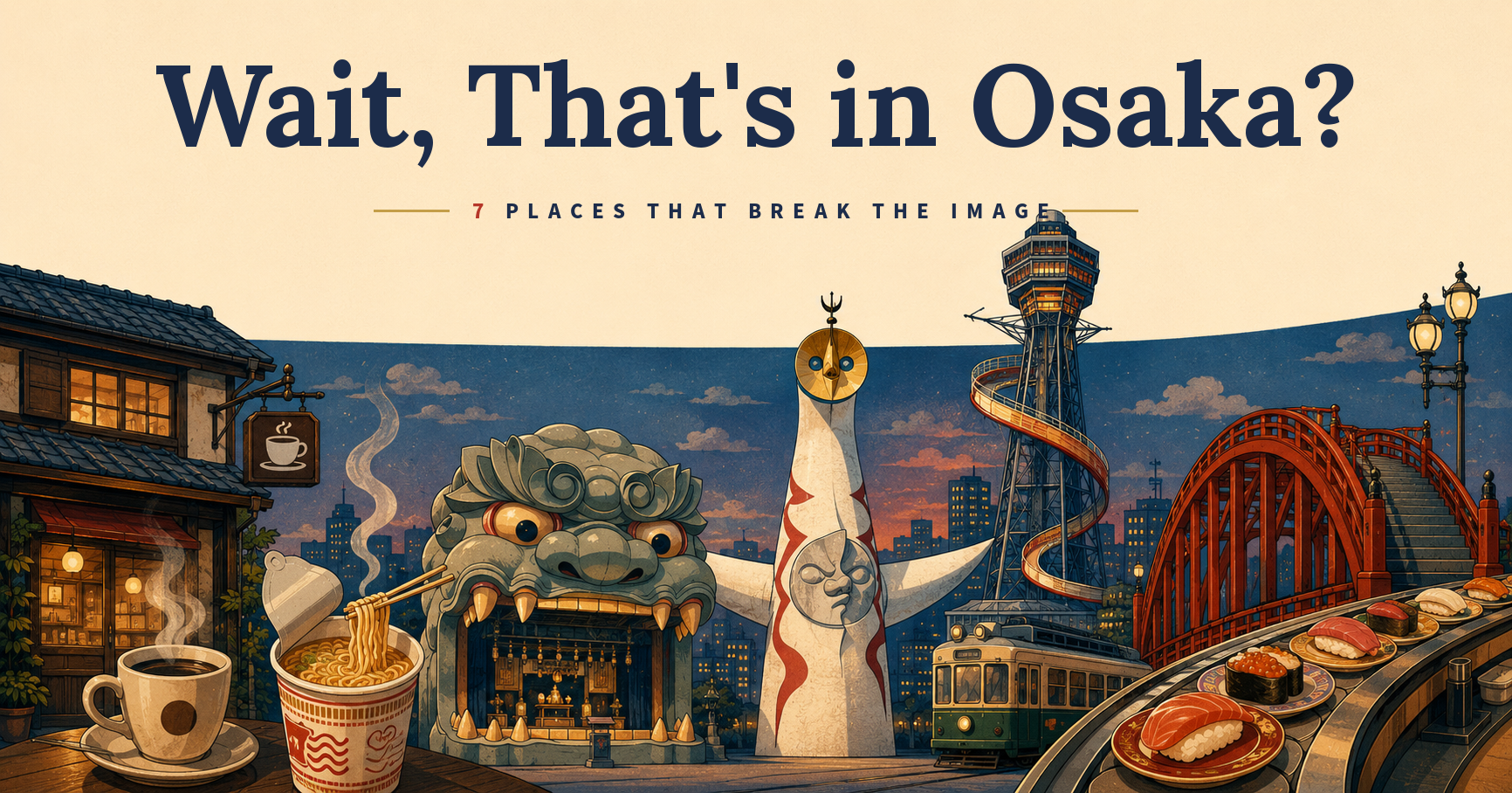
This is a closer look at stop #1 from Wait, That’s in Osaka? — 7 Places That Break the Image. Next in the series:
【Related Articles】