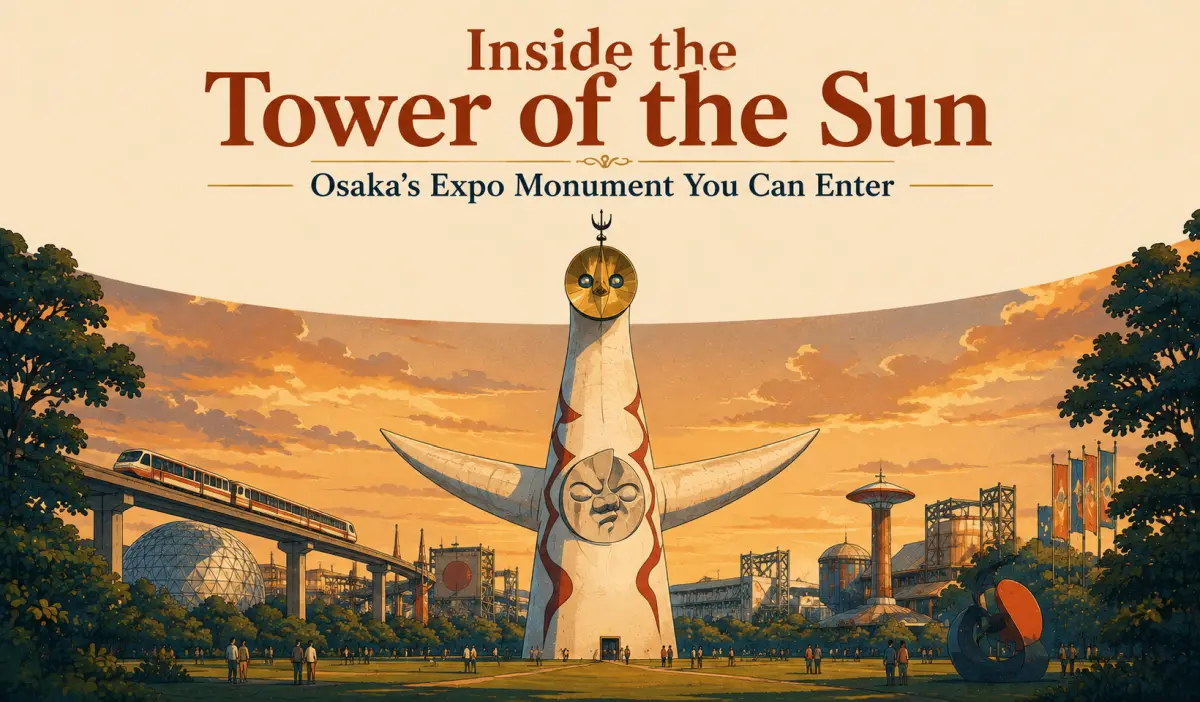
In our list of seven places that break the image of Osaka, this was number four, and it’s the one people assume they’ve already “seen.” The Tower of the Sun is the strange, three-faced monument that the artist Tarō Okamoto built for Expo ’70. Most visitors glimpse it from a train or a photo and move on. What almost no one abroad realizes is that you can go inside — and that the inside is even stranger than the outside.
A monument you can enter
For nearly fifty years, the Tower was sealed. Then, in 2018, after a seismic retrofit and a full restoration, it reopened to the public. Step in and you’re met by the “Tree of Life” — a 41-meter sculpture threading up through the tower, hung with models of creatures charting the evolution of life from single cells upward, exactly as it looked when the world walked through it in 1970. Okamoto designed the whole interior as one immersive space, down to the sound and the way visitors move through it. It’s less a museum than a walk inside someone’s imagination.
The Tower itself has three faces, each pointing at a different time: the Golden Face on top (the future), the Sun Face on the front (the present), and the Black Sun on the back (the past). A fourth, the underground “Sun of the Underground,” was lost for decades and has been recreated.
Book before you go
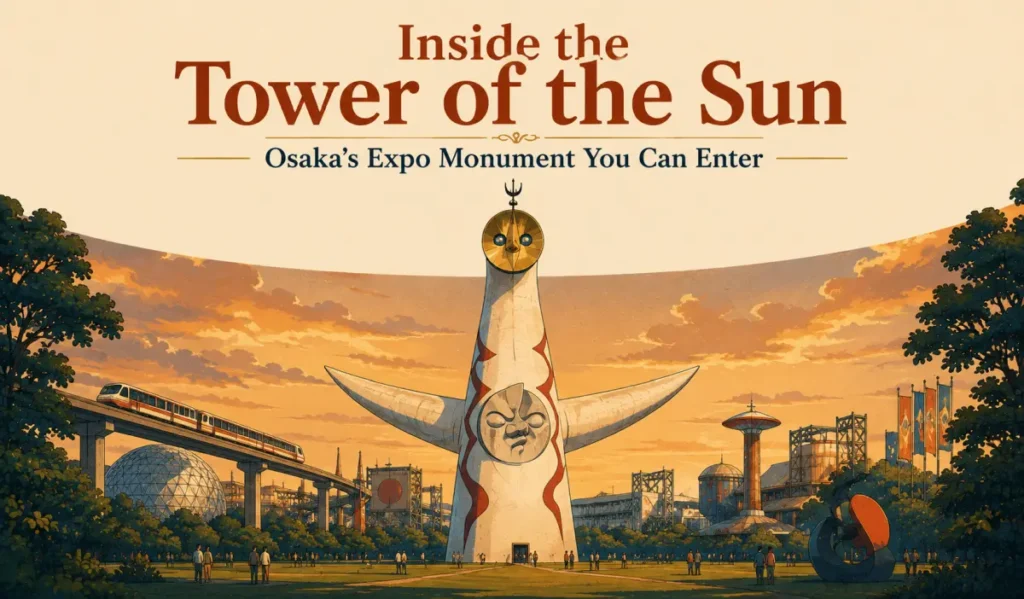
This is the practical part that trips people up. Interior viewing runs on advance reservation — you book a time slot on the official site before your visit. Same-day tickets are sometimes sold if there’s space, but they’re not guaranteed, and slots fill. If seeing the inside matters to you, reserve ahead rather than turning up and hoping.
Access: Expo ’70 Commemorative Park, Bampaku-kinen-koen Station (Osaka Monorail). The park itself is large and worth extra time.
Why it belongs on your Osaka list
There’s a timely reason to go now. Osaka hosted the World Expo again in 2025 — and standing inside the surviving symbol of the last one, a monument that was only ever meant to last six months and instead became permanent, gives you the whole arc of the city’s ambition in a single room. It’s the opposite of the loud, food-first Osaka most people picture, and that gap is exactly what this series is about.
This is a closer look at stop #4 from Wait, That’s in Osaka? — 7 Places That Break the Image. More in the series: