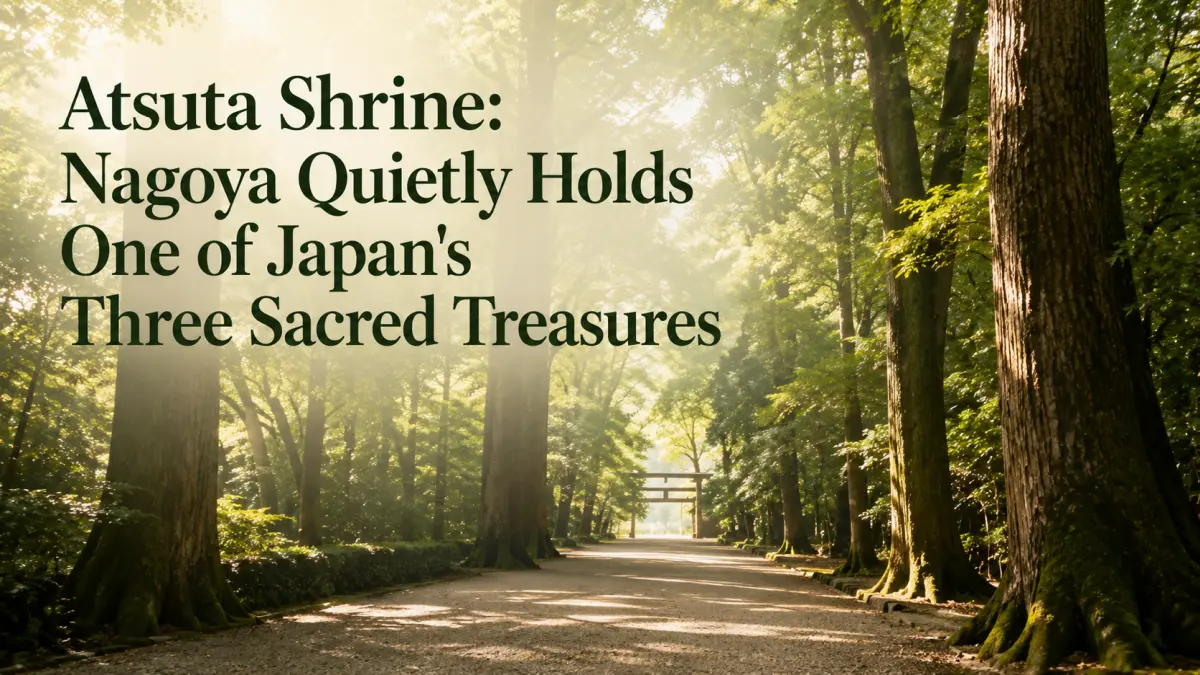
Almost every visitor to Japan has heard of Ise, the country’s holiest shrine. Almost none has heard of the shrine that tradition ranks just below it — and it sits, largely unnoticed, in southern Nagoya. Atsuta Jingū is said to hold the Kusanagi sword, one of the three Imperial Regalia that symbolize the legitimacy of Japan’s throne.
A city everyone skips is home to one of the nation’s most sacred objects, and the gap between that significance and its fame is the entire reason to walk through the gates.
What’s Actually Here: One of the Three Imperial Regalia
Japan’s imperial line is symbolized by three sacred treasures: a mirror, a jewel, and a sword. The mirror is at Ise; the sword — Kusanagi-no-Tsurugi — is said to be enshrined here at Atsuta, and has been, by tradition, for around 1,900 years.
The shrine’s deity is understood as the sun goddess Amaterasu embodied in that sword, which places Atsuta, in spiritual standing, second only to Ise itself.
Here’s the catch that turns out to be the point: you will never see it. The sword is kept deep in the inner sanctuary and has never been shown to the public — the same arrangement as the sacred mirror at Ise.
Even the imperial family accesses it only on the rarest occasions; the most recent was the current Emperor’s enthronement in 2019. So you don’t come to Atsuta to look at a sword in a case. You come to stand in the place where a myth is said to physically rest, unseen — and, oddly, that weightlessness is heavier than any display could be.
The Legend Worth Knowing Before You Go
The story is one Japanese children grow up with. The hero-prince Yamato Takeru carried the sword on a campaign in eastern Japan; ambushed in an open field, his enemies set the grass on fire to trap him. He used the blade to cut the burning grass away and turned the flames back on his attackers, escaping alive — and from that moment the sword was called Kusanagi, the “grass-cutter.”
After his death, his consort Miyazu-hime enshrined the sword here, a moment traditionally recorded as the shrine’s founding. It appears in the Kojiki and Nihon Shoki, Japan’s oldest chronicles.
The shrine is woven into real history too. In 1560, the warlord Oda Nobunaga stopped here to pray for victory before the Battle of Okehazama — then won against overwhelming odds in one of the most consequential battles in Japanese history. Knowing that as you pass the main hall changes how the place feels.
What You Can Actually See and Do
Even without the sword on view, there’s more than enough here.
The grounds themselves are the first surprise: a 190,000-square-metre sacred forest in the middle of the city, with camphor trees said to be over a thousand years old.
Step past the gate and the traffic noise genuinely falls away — the long, green approach is meant to settle you before you reach the main hall, and it works.
At the main hall, the standard way to pray is two bows, two claps, one bow. Photography is fine from in front of the hall, but the inner sanctuary is off-limits; skip the flash and tripod out of respect.
For anyone drawn to the sword theme, the Kusanagi-kan, a museum opened in 2021, is the closest you’ll get — it displays historic blades including National Treasures, and has a hands-on corner where you can lift sample swords to feel their weight.
Nearby, the smaller Hakkengū is a parallel sanctuary dedicated to the spirit of the sword; it draws far fewer people, and locals tend to bow at the main hall first, then here.
Eat Before You Leave
Two of Nagoya’s signature dishes are waiting right at the shrine. Kishimen — the city’s flat, silky udon — is served at a well-known stand on the grounds. And just beside the shrine sits Atsuta Hōraiken, the restaurant credited with inventing hitsumabushi, Nagoya’s grilled-eel-over-rice. Pairing the shrine with the eel is the single most Nagoya way to spend a morning.
What Is Nagoya-meshi? The Bold Food Culture Kansai Can’t Give You

Practical Notes
Getting there is simple: Meitetsu Jingū-mae Station sits right beside the grounds, with JR Atsuta Station and the subway also close. Entry to the shrine grounds is free and open daily; the Kusanagi-kan and treasure museum keep their own hours and admission, so check the current details before you go: Atsuta Jingū official site (English).

Allow an hour or so for the grounds, more if you visit the museum — and time it around a hitsumabushi lunch next door.
Think about what this is: a treasure of the entire nation, kept forever out of sight, in a city the tour buses drive past. Nagoya doesn’t put it on a poster or sell you a viewing — it just quietly keeps it, and trusts the people who bother to come. That reticence is the city in miniature, and Atsuta is one of the clearest places to feel it.
Wait, Nobody Skips Osaka. So Why Does Everyone Skip Nagoya?