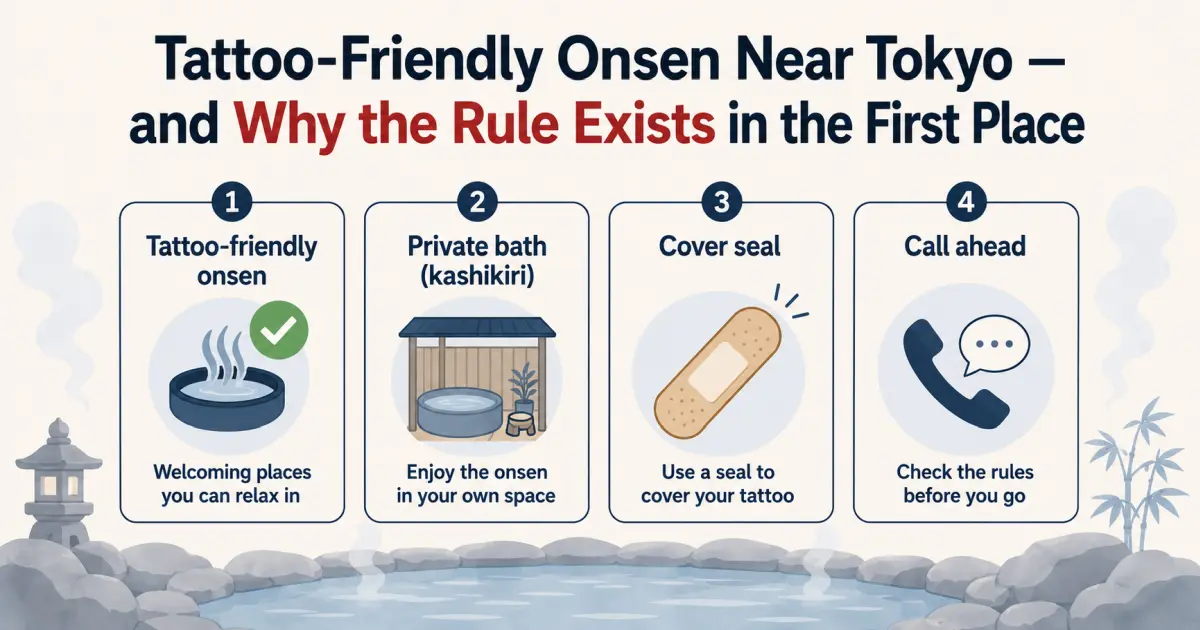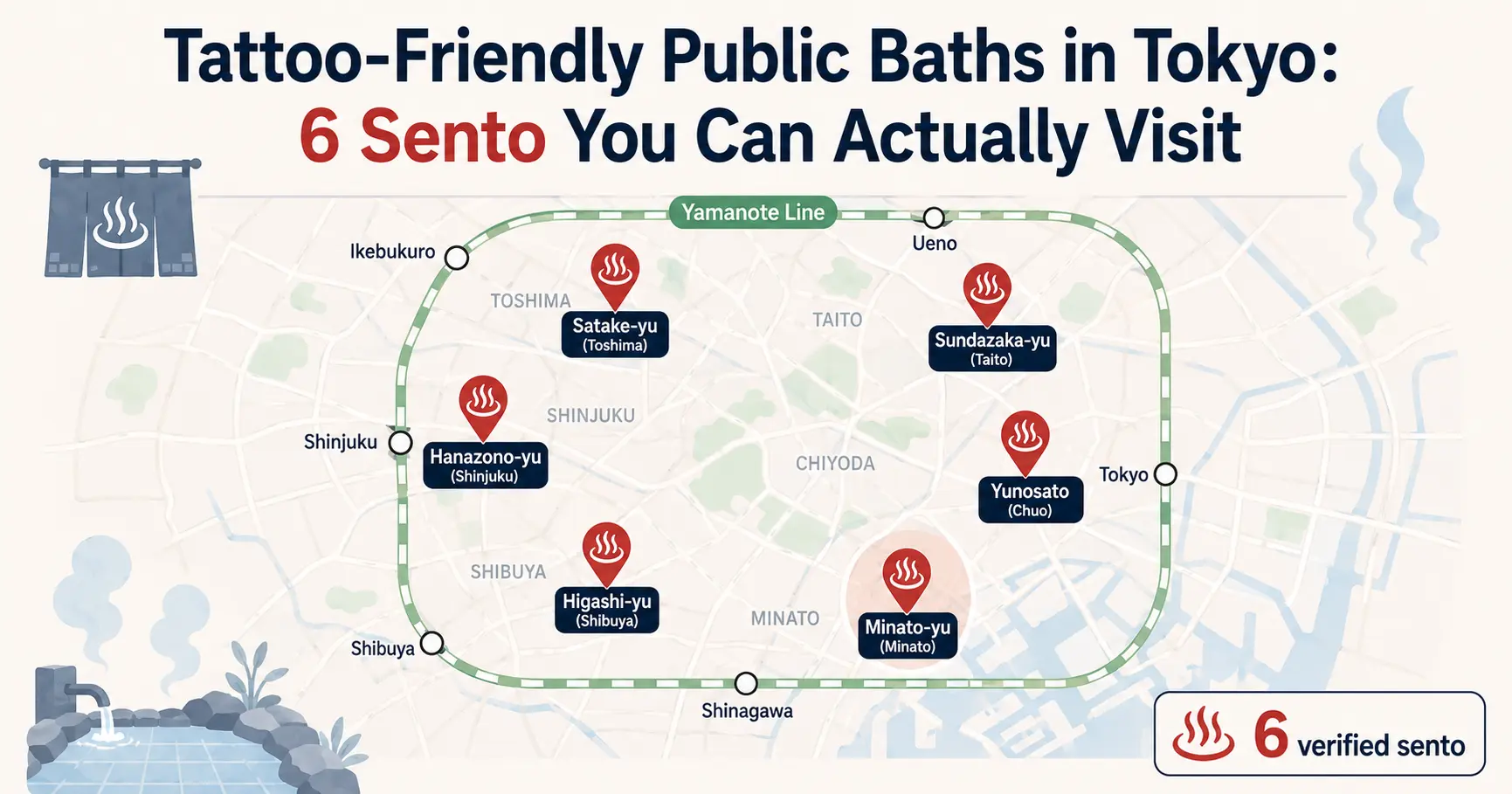
If you’ve read our guide on why some onsen turn tattooed guests away and how to soak anyway, this is the companion you actually take with you: six real bathhouses in Tokyo that welcome tattooed bathers.
All are neighborhood sento — public baths woven into everyday life — so you get the genuine article, not a tourist facility. Each sits within easy reach of central Tokyo, and your Suica or PASMO covers the trip.
One habit worth keeping, though: policies can change without notice. Treat this as a strong starting point, and confirm with the bath directly before a special trip.
Before You Go: Three Quick Habits
These baths are relaxed about tattoos, but they’re still shared local spaces. A little awareness keeps you welcome:
- Wash fully at the shower stations before entering the bath. The soak is for clean bodies only.
- Keep your small towel out of the water — rest it on your head or the tub’s edge.
- No phones or photos in the bathing area. These are private, camera-free spaces.
Most sento cost only a few hundred yen to enter. Bring a 100-yen coin for lockers, and a small towel (or rent one at the desk). Payment is often cash, though some take IC cards.
Six Tattoo-Friendly Sento in Tokyo
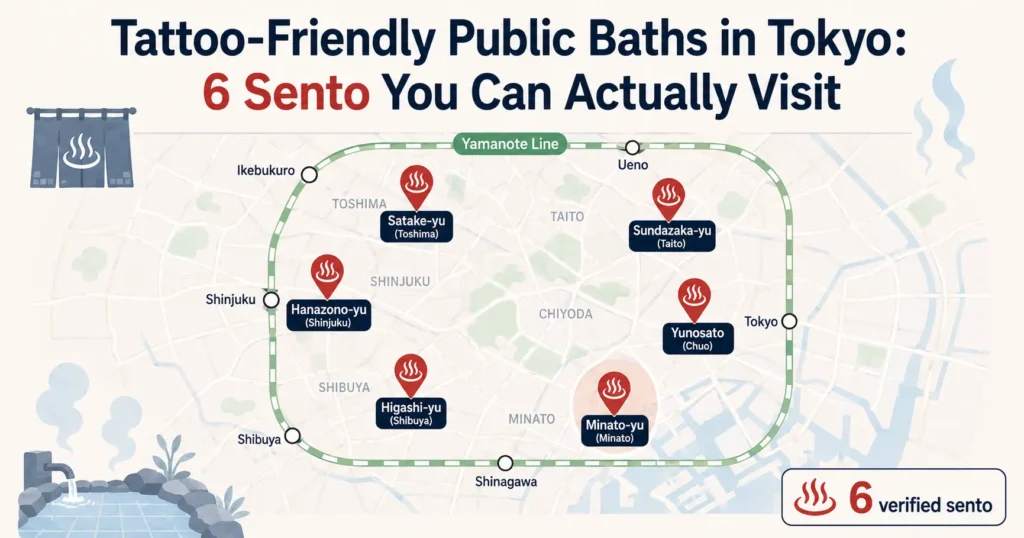
Google Map
Note: English support may be limited. If you call ahead, a simple “Tattoo daijobu desu ka?” (“Are tattoos OK?”) goes a long way.
1. Kairyo-yu (Shibuya)
A stylish, design-forward sento tucked between Shibuya and Ebisu, popular with a young crowd for its moody dark-blue bathing hall. Soft-water baths, a carbonated bath, and a hot infrared sauna. An easy one to fit into a day of sightseeing or shopping.
- Access: ~12 min walk from Shibuya or Ebisu Station
- Hours: 12:00–23:30 (check before you go)
- Official site (English): kairyou-yu.com/en
2. Kotobuki-yu (Taito)
A classic temple-style bathhouse two minutes from Inaricho Station, near Ueno. Known for one of the largest open-air baths of any sento in central Tokyo, plus multiple saunas and cold baths. Generous amenities and a welcoming, traveler-friendly feel.
- Access: ~2 min walk from Inaricho Station; ~10 min from Ueno
- Hours: 11:00–late (roughly to 1:30 AM); closed the 3rd Thursday
- Official info (English): English listing
3. Daikoku-yu, Oshiage Onsen (Sumida)
A genuine hot-spring sento in the shadow of Tokyo Skytree, with a rooftop open-air bath, real onsen water, and famously long hours — open through the night until 10 AM. One of the most tourist-friendly baths on this list, and a favorite for a Skytree-area soak.
- Access: ~6 min walk from Oshiage Station; ~10 min from Skytree
- Hours: vary by day; closed Wednesday (confirm on the site)
- Official site (English): daikokuyu.com/english
4. Yudonburi Sakae-yu (Taito)
A natural hot-spring sento near Minowa, where even the showers run onsen water. A wide, open-air bath, a signature “donburi” tub, sauna, and fine-bubble baths. Multiple Google reviewers with full sleeves and leg pieces report soaking here without any issue.
- Access: ~10–12 min walk from Minowa Station
- Hours: 14:00–23:00 (Sun/holidays from 12:00); closed Wednesday
- Official site (English): sakaeyu.com/en
5. Matsumoto-yu (Nakano)
A crowd-funded renovation turned this Higashi-Nakano bath into one of the area’s most modern sento — clean, spacious, with a wide range of baths (bubble, medicinal, electric), cold baths, and a sauna. A great first-timer choice, reachable from three different lines.
- Access: ~3 min from Ochiai Station; ~8 min from Higashi-Nakano
- Hours: 14:00–24:00 (Sun from 8:00); closed Thursday
- Official site: matsumoto-yu.com
- Note: English support may be limited — please confirm before visiting. [TO UPDATE after phone check]
6. Hotta-yu (Adachi)
An 80-year-old bathhouse near Nishiarai, beautifully renovated with a striking tile mural, a large open-air bath, an herbal sauna, and a deep cold bath. A little further out, but a rewarding, down-to-earth local soak away from the crowds.
- Access: ~7 min walk from Nishiarai Station
- Hours: 14:00–24:00 (Sat/Sun/holidays from 8:00); closed 2nd Thursday
- Official site: 4126.tokyo
- Note: English support may be limited — please confirm before visiting. [TO UPDATE after phone check]
Getting There
Every bath on this list is a tap-and-go trip on the Tokyo rail network — grab an IC card first if you haven’t. Our Suica guide covers how to get one at Haneda and top it up (including the Visa quirk that catches travelers out).
Please note: Each facility’s policy on tattoos reflects information available at the time of writing. Policies can change with a change of management, and can vary by the size or extent of a tattoo, the season, or how busy the bath is. Always confirm the current policy directly with the facility before your visit. This site accepts no responsibility for any inconvenience arising from reliance on the information here. Public baths are shared spaces — please wash before entering, keep towels out of the water, and bathe quietly out of respect for other guests.
Part of: Japan, Made Simple
This guide is one piece of Japan, Made Simple — a local’s answers to the practical stuff no guidebook explains well, from payments and trains to onsen rules and hard-to-get tickets. Start there to find the next thing you need to sort out.