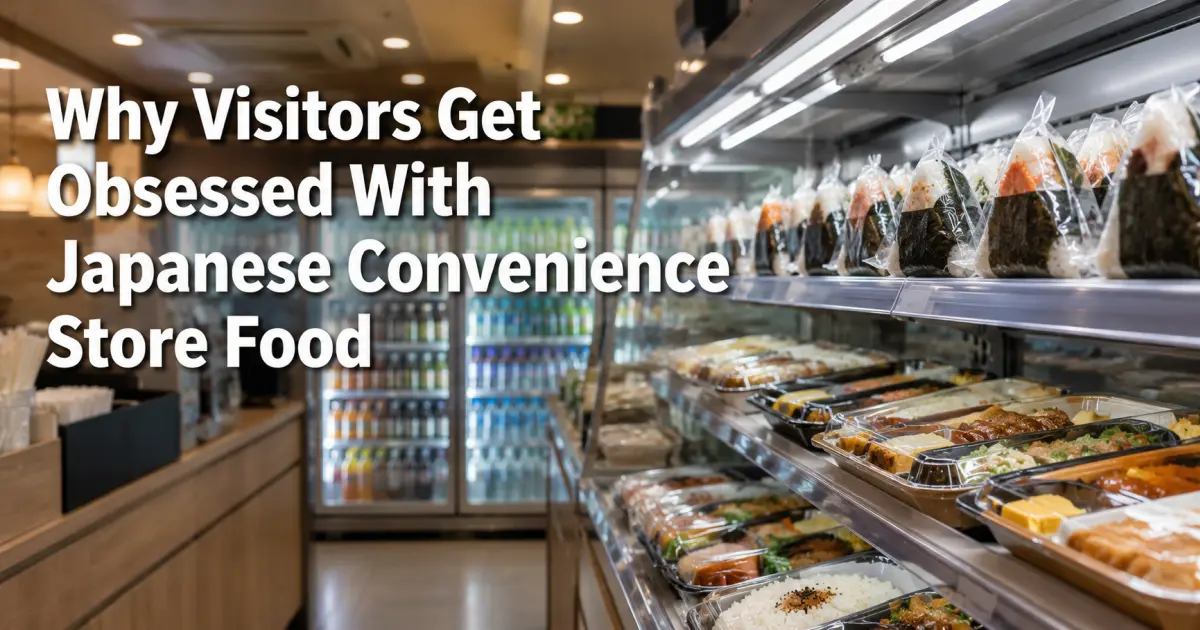
“I went in for a drink and came out thirty minutes later.”
Almost every visitor to Japan ends up saying some version of this. The place in question is not a temple or a famous market. It is a convenience store on an ordinary street corner. Plenty of travelers admit they went back every single day of their trip.
To people who live here, these shops are so ordinary they have stopped being visible. To people arriving from abroad, they have become something to experience.
Before anything else, one practical reassurance: there is nothing to learn. You walk in, pick things off the shelf, and pay. No ticket machine, no ordering system, no language required. The small details worth knowing are covered near the end of this article, but none of them will stop you at the door.
So the real question is a different one. Why is the food this good in the first place? And the answer has almost nothing to do with tourists.
How an Ordinary Shop Became a Destination
A different definition of convenience
In most countries, a convenience store sits beside a gas station. Drivers stop for fuel and pick up chips and soda. Nothing more is expected of it.
In Japan, the same idea grew into a different creature.
You can buy a full meal, pay your utility bills, ship a parcel, collect concert tickets, withdraw cash, make photocopies, and use a spotless bathroom. The lights stay on all night. An entire layer of daily infrastructure fits inside a room you can cross in twenty steps.
What surprises visitors is less the range of products than the density. Functions that live in separate buildings back home have all been folded into one small space, and delivered at roughly the same standard in every town in the country.
Who it was actually built for
This is the part most guides skip.
Japanese convenience stores did not evolve for tourists. They took their current shape because life in Japan changed, and the shelves kept adjusting to keep up.
Look at how households are structured. In a 2024 national survey, the single largest household type in Japan was people living alone, at 34.6 percent of all households. Single-person households now outnumber the married-couple-with-children family that was once treated as the default. When most households are one person, the shape of a meal changes with them.
Cooking a large pot and dividing it among a family stops making sense. What is needed instead is one portion, ready to eat, right now.
Add to that dual-income households becoming standard and long working hours squeezing out the time to cook from scratch. The result has been decades of growth in what Japan calls nakashoku, prepared food bought and eaten at home. According to the Japan Ready-made Meals Association, the market reached roughly 11.7 trillion yen in 2025, up 3.7 percent from the year before, and it has expanded around one and a half times over the past twenty years. Of all the retail formats competing in that market, convenience stores hold the largest share.
So convenience store food here is not an exotic novelty arranged for visitors. It is a practical product, refined over decades against a demanding everyday requirement: one portion, immediately, with no disappointment.
That is where the quality comes from. When travelers ask why an onigiri or an egg sandwich tastes engineered, the honest answer is that it has been improved year after year, not because it is a tourist attraction, but because it is what people here actually eat.
The value of never getting it wrong
Eating in an unfamiliar country is a gamble. You cannot read the menu, cannot judge the price, cannot predict what will arrive. A bad guess costs you one of a limited number of meals.
A convenience store removes that risk entirely. Prices are printed, photos are shown, packaging tells you most of what you need, and even a poor choice will not be genuinely bad.
Late-night arrivals, jet-lagged mornings, evenings when everything else has closed. The konbini quietly fills the gaps in an itinerary. When visitors say they went every day, the first reason is usually relief rather than excitement.
Why it became a phenomenon now
The attention is recent, though.
Part of the trigger was the period when travel was restricted and the visitors who did arrive found their options narrow. A shop used out of necessity turned into a discovery. Individual posts spread, arrivals surged, and the effect compounded.
What is interesting is the shape of the story. It never spread as a grand claim about Japanese excellence. It spread as thousands of small personal surprises about a particular sandwich. That is easy to imitate, which is why the next arrival stops in front of the same shelf.
What Is Actually Worth Eating
Onigiri and bento boxes
The rice ball is usually the first thing visitors try and the thing they rate highest.
The reason is structural. The seaweed is sealed away from the rice by a film so it stays crisp, and you wrap it yourself as you open it. You can eat it with one hand, and the wrapper contains its own mess. Salmon, kombu, pickled plum, and tuna mayonnaise are the standards, and most start around 150 yen.
Bento boxes follow the same logic, optimized as a single person’s meal. The ratio of rice to dishes, how the texture holds up after the microwave, seasoning that still works when the food has cooled. All of it comes from decades of being eaten daily by people who would notice.
When visitors compare it to a train station bento, they are reacting to the fact that something close to a special-occasion meal is sitting on the shelf at an everyday price.
Egg sandwiches, bread, and breakfast
If one item has to represent Japanese convenience stores abroad, it is probably the egg sandwich.
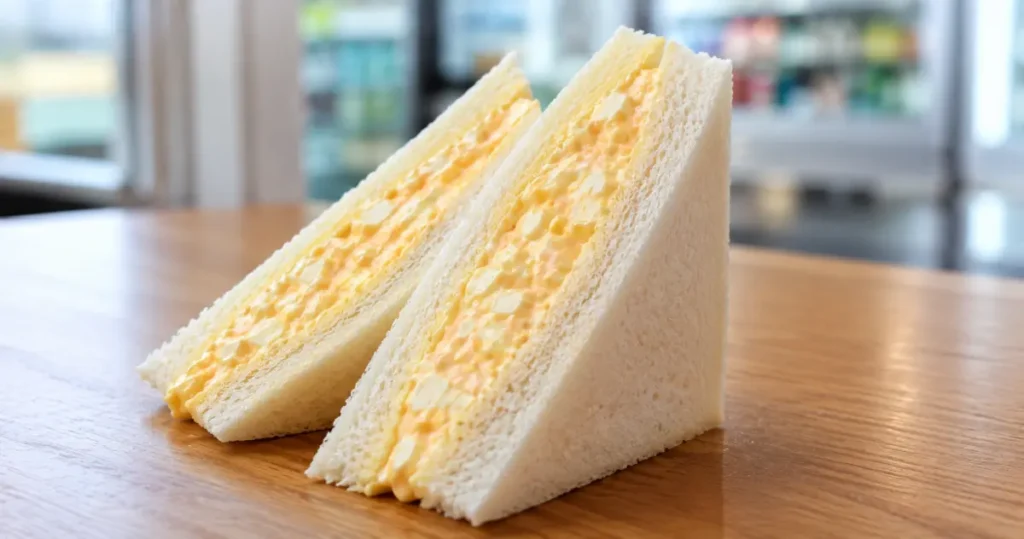
The crusts are removed, the bread collapses softly in the mouth, and the egg filling is bound with a slightly sweet mayonnaise. The design philosophy is simply different from a typical Western sandwich. Japanese shokupan bread, light and faintly moist, is doing most of the work.
Breakfast is a deep category too. Sweet rolls, savory filled breads, salads, yogurt, and hot coffee. When the hotel breakfast disappoints or the train leaves too early, travelers assemble a morning from these shelves. Search interest in konbini breakfast has climbed sharply overseas in the past year, which suggests the habit is settling in.
Hot snacks at the counter
The heated case beside the register is the other face of these shops.
Fried chicken, sausages, steamed pork buns, fries. In the thirty seconds you spend paying, all of it sits steaming at eye level. Adding something you had no intention of buying is a universal experience, and locals are no more immune than visitors.
Each chain treats its fried chicken as a flagship product, which makes comparing them a small sport. Seasonal items like winter pork buns and oden register strongly with travelers precisely because they exist only during a particular visit.
Sweets, ice cream, and snacks
As a souvenir aisle and as an immediate treat, this is the deepest trap in the store.
Konbini desserts approach specialty-shop quality for a few hundred yen: custard puddings, roll cakes, dorayaki, coffee jelly. The ice cream freezer carries matcha and sweet red bean flavors as though they were unremarkable, which to Japanese shoppers they are.
Packaged snacks are worse, in the best sense. Familiar products cycle through limited-run flavors without pause. Matcha, sakura, region-only editions. That deliberate scarcity lands directly on a traveler’s collecting instinct, and suitcases fill up accordingly.
Drinks, coffee, and alcohol
Visitors often comment on the sheer width of the drinks wall. How many kinds of tea can there be. Green tea, barley tea, roasted hojicha, oolong, and the fact that unsweetened is the default rather than an exception is itself unusual from the outside.
Fresh coffee deserves its own mention. For a little over 100 yen, the machine produces something close to café standard. The controls confuse people once, and then become a morning habit.
Alcohol is well stocked as well: canned beer, chuhai, cup sake, small bottles of whisky. Buying it involves an age confirmation step where you tap the screen yourself, which catches many visitors off guard the first time.
Which Convenience Store Is Best in Japan?
This question gets asked constantly by visitors, because the answer that locals hold instinctively is invisible from outside.
Broadly, each chain has a territory. 7-Eleven is strong on the staples, especially rice balls and bento. Lawson pushes hardest on desserts and baked goods. FamilyMart makes its name on hot snacks from the fried case and on its own-brand products.
Treat that as a rough guide rather than a verdict. All three compete in every category and rotate products on short cycles, so whichever chain is ahead in a given aisle changes with the season.
One more thing shapes the choice: limited collaborations. Anime and character tie-ins run for fixed periods at specific chains. If you are chasing one of those, the right store is decided by the campaign calendar, not by the food.
Using a Konbini Without Thinking About It
A first-visit shortlist
Trying everything at once ends in paralysis. For a first run, this combination covers the range: one onigiri, an egg sandwich, fried chicken from the counter case, a green tea, and one dessert.
Konbini hacking
A game has spread online recently of combining products into something new. Adding rice ball filling to instant noodles, dipping soft serve into a particular packaged sauce, and so on.
People here have been doing this for years. What is new is that it acquired a name and an audience. Everyday improvisation never looks like invention to the people doing it.
The small things that catch people out
Paying. Cash works everywhere. Most stores also take credit cards and transit IC cards like Suica or Pasmo. On many registers you place cash into a machine yourself rather than handing it to the clerk.
“Do you want a bag?” You will be asked this, in Japanese, at almost every purchase. Plastic bags are no longer free and cost a few yen. A nod or a shake of the head is a complete answer.
Heating. Staff will ask whether to microwave your bento or hot food. Saying yes is expected, not an imposition. Chopsticks or a spoon come with it.
Eating in. Many branches have seating. Note that the tax rate can differ between eating in and taking away, so you may be asked to state which you intend.
Trash. Bins are usually inside the store or just outside the door. Since public bins are scarce in Japan, these matter to travelers. The convention is to dispose of what you bought at that store rather than carrying in outside garbage.
The Shelf as a Portrait of a Country
It would be easy to summarize all of this as Japanese technical skill or a national instinct for service. That explanation is only half right.
The Japanese convenience store is what happens when businesses spend decades answering a society where the most common household is one person, where the hours available for cooking keep shrinking, and where the day does not stop at night. One portion, immediately, reliably good. Repeated long enough, that requirement produced a density of function that has no real equivalent anywhere else.
What visitors are reacting to, then, is not really the food. It is the shape of ordinary life here, visible through the food.
Which makes the shop most people walk past every day something stranger than it looks: a room where a country’s social change has been quietly arranged on shelves.
Next time you step inside, try looking at it with someone else’s eyes.
konbini / convenience store / Japanese food / Japan travel / onigiri / bento
What’s Actually Trending in Japan — and Why It’s Happening