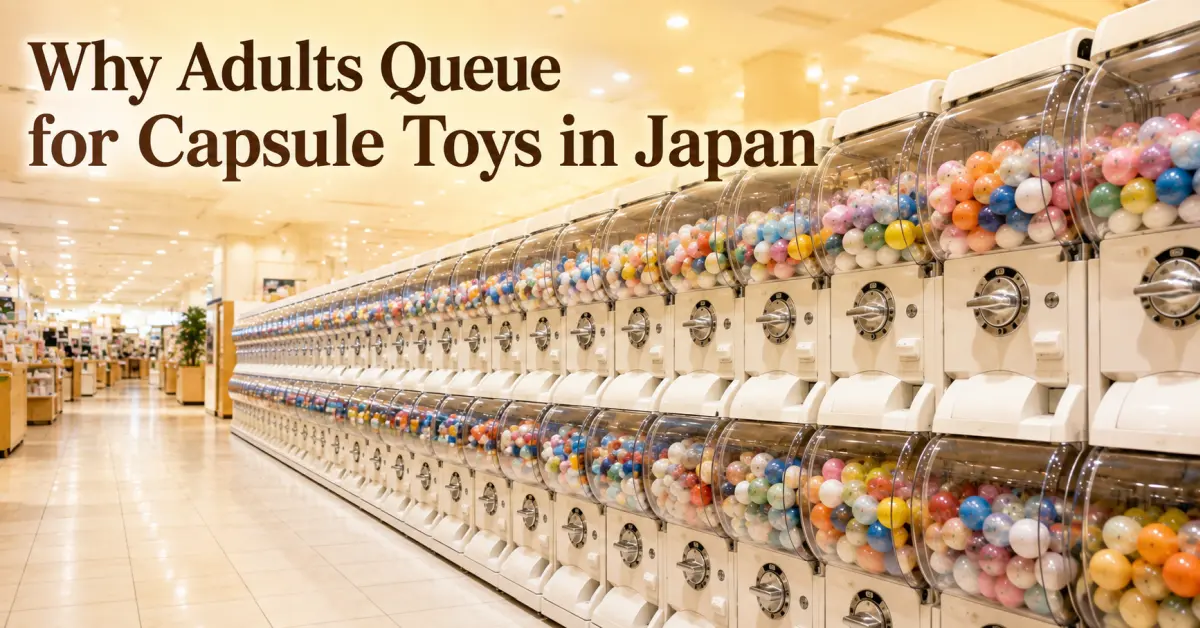
A summer morning in a department store attached to a train station. Walking past one corner of the shop floor, there was a line of people waiting for the doors to open.
At the end of the line was a capsule toy section.
I assumed the queue was children. It was not. Most of the people waiting were adults. Some looked around the age of a parent, a few around the age of a grandparent. Everyone stood quietly, waiting for opening time.
Three hundred yen a turn. You cannot choose what you get. For a small toy that arrives at random, people were lining up before the shop opened.
When did this happen, and why now?
What Is Actually Happening on the Shop Floor
Queues, numbered tickets, and lotteries
On release days for popular items, lines of several hundred people have been reported. Selling out within hours has become normal. Some stores now hand out numbered tickets, and when the crowd is too unpredictable for that, they switch to a lottery. Purchase limits are common. In a few cases, sales have been postponed or cancelled outright for safety reasons.
A lottery means you cannot turn the handle unless you win the draw first. The right to spend your 300 yen is itself allocated in advance.
In May 2026, queues, instant sell-outs, and resale activity around Chiikawa and Super Mario charm sets were reported across multiple Japanese media outlets.
There was a time when a gachagacha machine was something you noticed on your way past and turned on impulse. It was not something you queued for.
From stumbling across it to hunting it down
The simplest way to describe the change is that the chance encounter has disappeared.
The old pattern was to spot something on the shop floor and turn the handle on the spot. The new pattern is to check restocking information on social media or a store’s announcements, then travel to the location that has it. Sold-out reports and restock notices are now the reason people leave the house.
Instead of meeting a product at the shop, people search for a product and then go to the shop. The order of events has reversed.
The numbers behind the fifth boom
The scale shows how fast this happened.
According to the Japan Capsule Toy Association, the market reached roughly 196 billion yen in fiscal 2025 on a manufacturer shipment basis, up 39 percent from around 141 billion the previous year. That is close to one and a half times in twelve months.
Dedicated capsule toy stores passed 900 nationwide as of the end of January 2026, an increase of more than 200 shops in a single year. Over 700 new products are released every month.
Something new arrives daily, and something sells out daily. That is the shape of the market now.
Why Now: The Real Reason the Shops Multiplied
The vacancies the pandemic left behind
This is the part that explains everything else.
The current boom is generally traced back to the pandemic. Not, however, in the way you might assume. The reason is more mundane than a story about people buying toys while stuck at home.
Tenants left commercial buildings in large numbers. When foot traffic collapses, the businesses occupying the biggest floor space are the first to fail. Into the empty units went a format that could operate without staff: the capsule toy store.
Consider how well the format fits an empty retail unit. There is no register. Nobody needs to be present for a sale to happen. The number of machines scales to whatever floor space is available. Fit-out costs almost nothing.
So the reason those rows of machines now occupy a corner of every station building and department store is that a hole opened up in the property market at the same moment as a business model that needs no staff. The two happened to fit.
The boom did not create the shops. To a significant degree, the shops created the boom.
A retail business with no cash register
There is a second structural quirk here, and it matters more than it sounds.
In a convenience store or a supermarket, a sale is recorded the instant it happens. What sold, when, how many, and what remains. The register captures all of it.
Capsule toys work differently. The machine is the shop. Customers never carry anything to a counter. Coins accumulate inside the unit and capsules deplete, and until someone comes to collect the cash, it is difficult to see what has actually sold.
That quirk is what produces the current chaos.
Buyers want to know which store still has stock. But the shop side cannot easily know the exact remaining count in real time either. So the information moves to social media instead: a photo someone took of a shelf, a post saying a particular branch still had some this morning, a store notice announcing a sell-out.
Because there is no official inventory data, unofficial sightings become valuable. Part of the reason people queue is right here. If the only way to know is to go, you may as well go before opening.
Why Adults Are the Ones Waiting
The charm you can carry
The category driving the current boom is what Japan calls mejirushi, meaning a marker or identifier.
These are small charms designed to clip onto the handle of an umbrella, a water bottle, a bag, or a pouch, so you can tell your belongings apart from someone else’s. Nominally they are practical items. In practice they exist to be carried around and seen.
That distinction is doing a lot of work. A figure on a shelf ends its life at home. A charm clipped to something you carry goes out into the world every time you do. And it photographs easily.
The collection stays on display inside daily life. That is what locks the category into social media.
The practical range keeps widening too: pouches, drawstring bags, foldable shopping bags, even arm covers. Because the object is genuinely usable, buying it carries less guilt. Having a defensible reason to spend is not a small factor in why adults open their wallets.
A memory from the Heisei era
Some people in the queue describe the appeal as nostalgia, though not for the toys themselves.
They mean the era when mobile phones were hung with multiple straps, jangling as you walked. The act of decorating the thing you carry disappeared and has now come back.
Once phones became smartphones, there was nowhere left to attach anything. Cases got thin and were designed to resist ornament. The urge to decorate lost its outlet, and then charms that clip to umbrellas and bags arrived. Seen that way, it becomes clearer why this particular product landed so hard. (That connection is my own reading rather than something the industry claims.)
The steady stream of nostalgic characters being turned into capsule toys is aimed at the same generation. Something you loved as a child, available for 300 yen.
The satisfaction of getting the thing everyone is chasing
There is another feeling people describe, and it has nothing to do with the object.
It is the satisfaction of having obtained the thing everyone else is currently hunting.
That value is not in the product. It is manufactured by scarcity. Winning the lottery, arriving in time, finding one that happened to be left. Beating the odds is itself the reward.
The contents were always random. Now access is random too. That double uncertainty has turned buying into a game.
The people standing in for someone else
Not everyone in the queue is there for themselves.
There are fathers who receive a list from a daughter over messaging apps, check restock announcements, and return to the shop several times a week to turn the handle on someone else’s behalf.
The grandparent-aged people I saw in that line were probably there for similar reasons. Asked by a grandchild, or acting for one. If so, that queue was not simply evidence of adults hooked on toys. It was also a picture of family members standing in line for each other.
Five Waves
What is happening now is counted as the fifth boom in Japan.
The first arrived in the 1980s, built on 100-yen machines dispensing small rubber figures that children bought with pocket money. The whole thing fit inside a child’s budget.
Successive waves pushed the ceiling up. Full-colour character products appeared and the market widened to include adults. During the third wave, a series designed to perch on the rim of a drinking glass became a genuine phenomenon, and capsule toys began to read as homeware rather than as toys. The fourth wave raised the sculpting quality again and moved the standard price above 300 yen.
Then the fifth. Dedicated shops nationwide, 700 new items a month, and products you need to win a lottery to buy.
Read as a sequence, this is the story of a children’s product gradually becoming an adult one. Prices rose, sculpting became more precise, and the buying population aged with it. The queue outside the department store is the far end of that line.
What Happens After You Collect
Duplicates are not failures
When contents are random, you get the same item repeatedly. That used to be the losing outcome.
Not any more. Duplicates are held back for trading, swapped with people met at the machines or found online. Some collectors deliberately secure two of everything, one to use and one to keep.
Rather than completing a set, some describe the pleasure as accumulating turns.
Keeping a record
Collections get arranged on display boards, photographed, and posted as videos. It resembles the sticker albums of an earlier generation, rebuilt around capsule toys.
Buying is not the end of the activity. Arranging, recording, and showing are all part of it.
What the Randomness Is For
This is an era in which you can get exactly what you want. Search, and it arrives tomorrow. The options are endless and the reviews will save you from a bad choice.
In the middle of that, a 300-yen capsule toy still insists on not telling you what is inside. And recently it has stopped telling you whether you can buy one at all.
The inconvenience has become the value.
The people queuing at that department store were not really buying toys. They were buying an experience that refuses to go according to plan. Win and it feels good, lose and it stings. Three hundred yen for that swing.
Trace the reason Japan’s streets are lined with these machines and you end up at something as unromantic as commercial vacancy rates. Trace the reason people queue in front of them and you end up somewhere else entirely.
If you pass one of these shops while you are here, stop for a moment and look at who is turning the handles. The age range will not be what you expected.
gachapon / capsule toys / Japan trends / consumer culture / Tokyo
What’s Actually Trending in Japan — and Why It’s Happening