If you’ve spent any time on YouTube, you’ve probably met them from both directions. On one side, a slim Japanese woman on a variety show working her way through a mountain of ramen, smiling, chatting, somehow still elegant. On the other, a crowd at Coney Island roaring while a man in a bib inhales hot dogs against a ticking clock.
Both are “competitive eating.” But watch them side by side and you notice they aren’t quite the same thing. The rhythm is different. The mood is different. Even the reason people are watching feels different.
I’ve spent a long career watching how Japan turns ordinary human behavior into television, and eating is one of the strangest examples. Here’s what actually separates the Japanese “food fighter” from the American competitive eater — and what that difference quietly says about each culture.
The visible difference: a clock versus a mountain
Start with the mechanics, because they explain almost everything else.
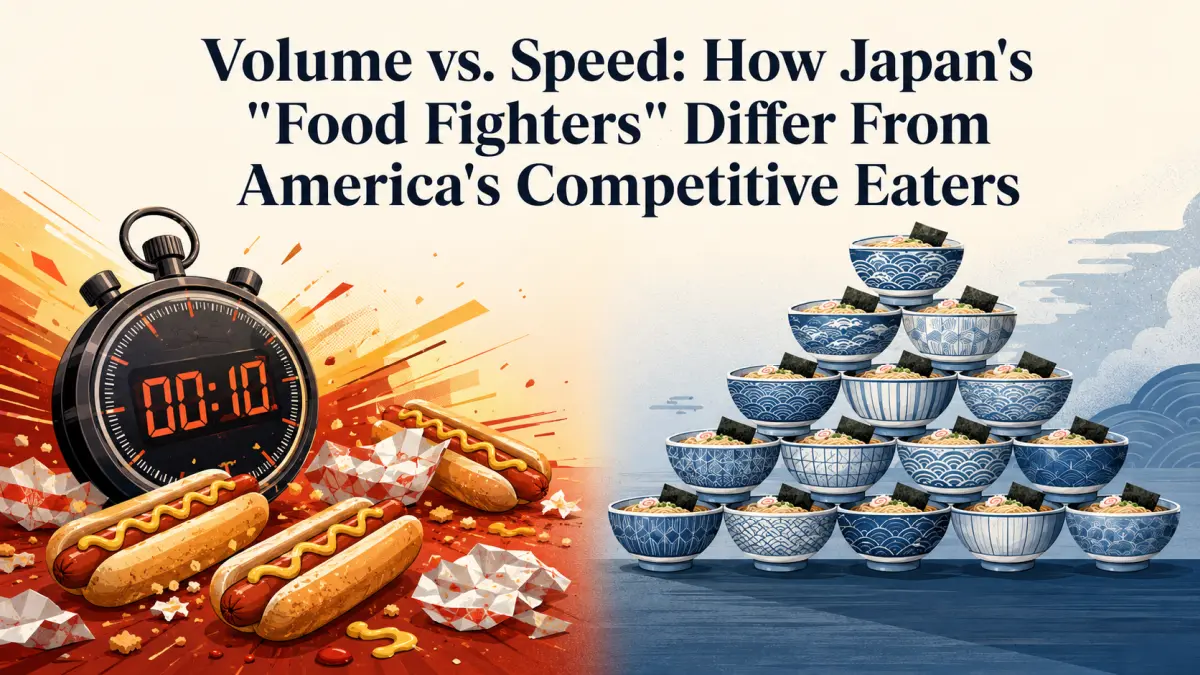
American eating contests are built around speed. Nathan’s Famous, the sport’s crown jewel, is exactly ten minutes long. One food, one timer, one number at the end. It’s loud, it’s messy, and it’s over fast. The drama is the countdown.
Japanese professional eating leans the other way. Contests can stretch close to an hour, and the goal is volume rather than raw speed. That single change reshapes the whole experience. When you have time, you don’t have to be grotesque. You can pace yourself. You can look composed. And so a peculiarly Japanese value crept in: eating beautifully. The most beloved eaters here aren’t the ones who eat most violently — they’re the ones who somehow stay graceful while doing the impossible.
The man who bridged both worlds noticed the gap immediately. Takeru Kobayashi, the Japanese eater who rewrote the American record books, once described the contrast in the audience itself. American crowds, he said, are rowdy and cheer you on. Japanese crowds sit quietly and watch with a kind of astonished focus, holding their emotion in. That’s not a small detail. It tells you the American event is a party, and the Japanese one is closer to a spectacle you observe — a performance you lean in to study rather than shout at.
Why Japan built this in the first place
None of this appeared by accident. Japan has been broadcasting big-eating as entertainment since the late 1980s, and it slowly evolved into something with its own logic.
The turning point in popularity came in 2000 and 2001. Kobayashi won a national TV eating championship by putting away sixteen bowls of ramen in an hour, then dominated a new, tense, genuinely competitive show called Food Battle Club. A thin, good-looking unknown demolishing the established veterans — it played like a sports drama, and the country was hooked. When Kobayashi took that skill to Nathan’s in 2001 and nearly doubled the existing hot dog record, Japan had, in effect, exported its own invention back to the country that thought it owned the hot dog.
Then came the part most overseas fans never hear about.
In 2002, a middle school student in Aichi Prefecture imitated these shows during lunch, raced a classmate to swallow bread, choked, and died. The public reaction was immediate. Networks pulled the big-eating and speed-eating programs off the air, and the first great boom ended almost overnight.
When the genre returned a few years later, it had changed its personality on purpose. The hard, gladiatorial, win-or-lose format faded. In its place rose a softer, variety-show version built around likeable characters rather than killers. This is the era of the charming TV eater — the performer you tune in for because you enjoy their company, not because you need to know who wins. Japan’s most famous big eaters today belong to this gentler tradition: the appeal is warmth, personality, and the oddly comforting sight of someone enjoying food without limit. The competition became a stage, and the eater became a friend.
America never had that particular rupture, so it kept drifting toward sport — rankings, rivalries, prize money, a governing body, the whole apparatus of athletics. Two countries, same raw activity, two completely different cultural containers.
The shared shadow
It would be easy to end there, with a tidy “Japan is gentle, America is loud.” But both versions share something less comfortable, and honesty requires naming it.
The most sobering example is Kobayashi himself. In 2024 he retired and spoke openly about the cost. After two decades of overeating for sport, he said his body felt broken — that he no longer reliably feels hunger or fullness, and can go days without eating at all. The man who made the whole spectacle glamorous ended up describing something closer to an injury than a career.
His case reopens a debate that runs in both languages: should competitive eaters even be called athletes? In Japan, people ask whether an activity built on excess can honestly be called a sport when sport is supposed to serve health. In America, the same question circles the same discomfort from the other side. Nobody has settled it, in either country.
I want to be careful here, because the point is not to shame the performers. The charming eater on your screen may be perfectly healthy and genuinely happy. The problem isn’t any single person. It’s the structure — an industry, in both cultures, that rewards eaters for going further, and an audience whose appetite for “more” is what keeps the machine running. The pressure doesn’t come from the eater. It comes from us.
What it says about us
So what does it mean that two very different cultures both turned eating into a thing we sit and watch?
Maybe it’s this. In societies where food is abundant and easy, the act of eating loses its old weight, and we go looking for it again through someone else — the thrill of excess without the consequence, performed safely on the far side of a screen. America dresses that impulse up as competition. Japan dresses it up as character and grace. But underneath, the hunger being fed is the viewer’s, not the eater’s.
That’s worth sitting with the next time a big-eating clip autoplays. Not as a reason for guilt, and not as a lecture. Just as a small moment of noticing: someone is performing abundance for you, and the shape that performance takes — a screaming clock in New York, a quiet mountain of ramen in Tokyo — is a surprisingly honest portrait of the culture doing the watching.
competitive eating / food fighter / oogui / Japanese TV culture / Takeru Kobayashi / Japanese food culture