You have just cleared customs at Haneda Terminal 3. You are jet-lagged, your phone is at 40%, and there is a train to catch. This guide gets you a working Suica in the next 15 minutes — and, just as important, makes sure you can actually put money on it. That second part trips up more travelers than the first, because if your card is a Visa, the top-up machine may quietly refuse it.
Here is exactly what to do, in the order you will do it.
What a Suica Is, in 30 Seconds
A Suica is a prepaid tap-to-pay card. You load money onto it, then tap it at train gates, on buses, and at convenience stores, vending machines, and most station shops. No paper tickets, no working out fares.
One thing that saves confusion later: a Suica works almost everywhere in Japan, not just Tokyo. Tap into a train in Osaka or buy a drink in Kyoto and it behaves exactly the same. So whatever you pick up at Haneda covers the rest of your trip.
The Three Options You Are Choosing Between
At Haneda you are really deciding among three things. The right one depends on your phone and how long you are staying.
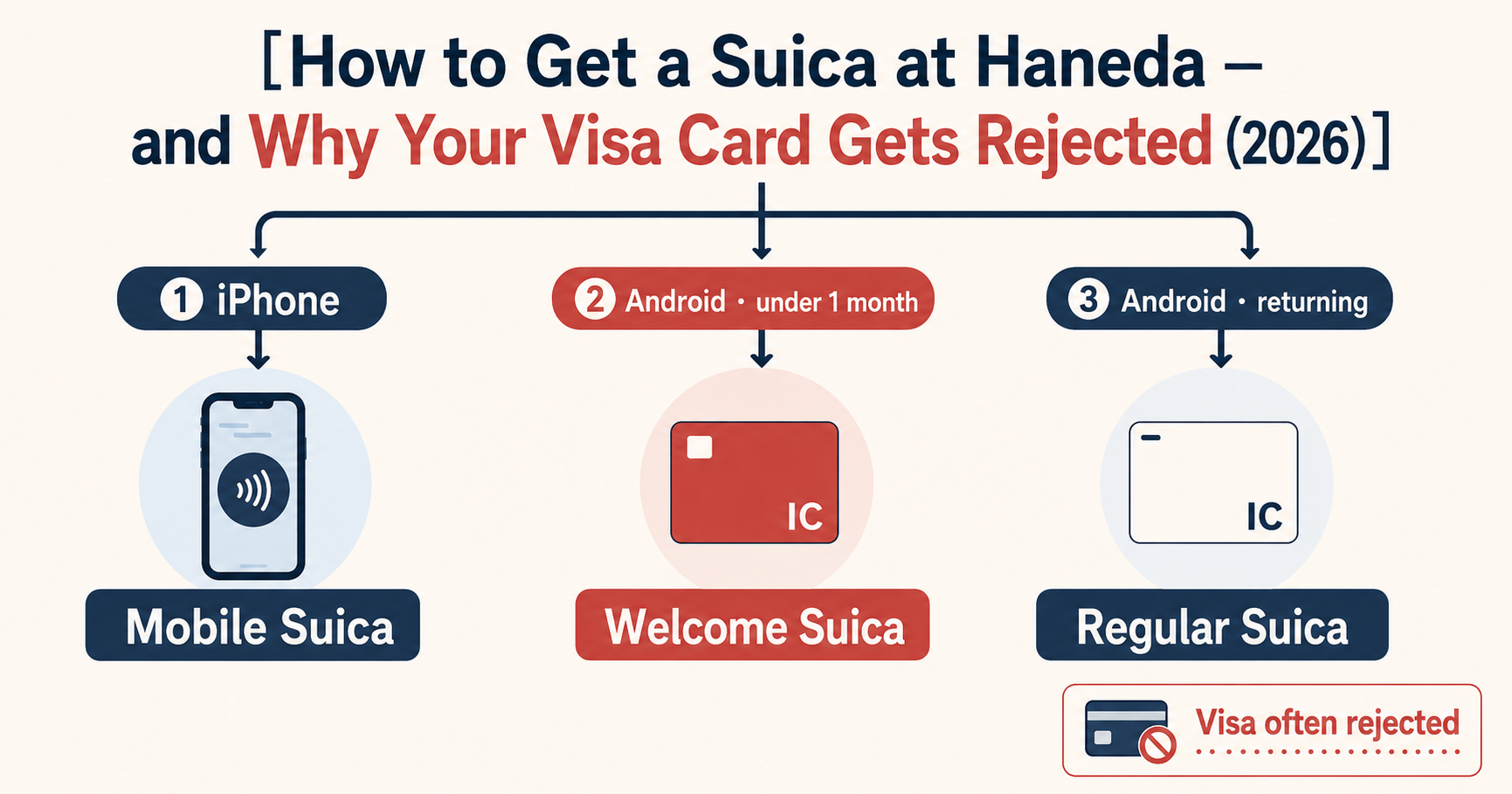
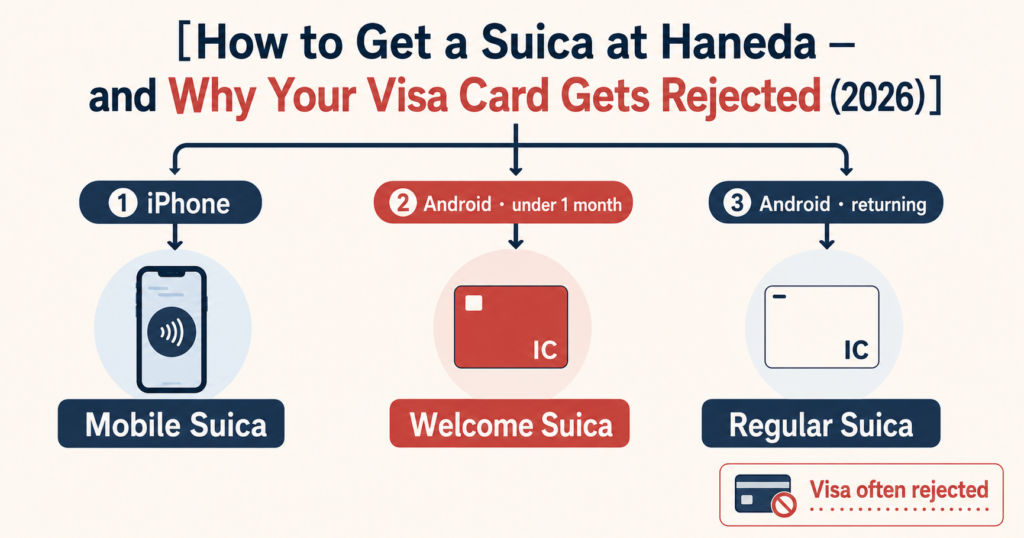
1. Mobile Suica on your iPhone
No card, no queue. You add a Suica inside Apple Wallet and tap your phone at the gate. If you have an iPhone (XR or later, iOS 17.2 or later), this is almost always the best choice — you can even set it up on the plane before you land. The one catch is charging it, which is the whole point of the credit-card section below.
2. Welcome Suica (the red tourist card)
A physical card made for visitors. No deposit, but it expires 28 days after first use and any leftover balance is gone — no refund. Good if you do not have an iPhone and are staying under a month.
3. Regular Suica
The standard physical card. It costs a ¥500 deposit, but it never expires and works on return trips. Better than the Welcome Suica if you think you will come back to Japan.
Quick rule of thumb: iPhone → Mobile Suica. Android, staying under a month → Welcome Suica. Android, might return → Regular Suica.
Where to Buy One at Haneda Terminal 3
All international flights land at Terminal 3, so this is where you will be. After you exit customs into the arrivals hall, follow the signs toward the monorail and Keikyu line — both train entrances are on the same floor, down toward the far end of the hall. The Suica machines and counter sit right by those entrances.
Two places sell physical cards there:
- JR East Travel Service Center — a staffed counter that sells the Welcome Suica. This is where the line is longest in busy seasons.
- Ticket vending machines — right by the entrance to the monorail area. Faster than the counter.
The insider move: if the Suica line looks brutal, walk a little further to the Keikyu line machines and buy a PASMO instead. PASMO is the same thing as Suica — same taps, same shops, same nationwide coverage — and its machines are almost always less crowded. Do not stand in a 20-minute Suica queue when an empty PASMO machine is 30 seconds away.
If you have an iPhone, skip all of this and set up Mobile Suica while you are still walking to the platform.
Charging It With a Credit Card: Read This Before You Try
This is where travelers get stuck, so it is worth 60 seconds of your attention.
The Visa problem
If you try to load your Mobile Suica through Apple Pay with a foreign-issued Visa card, it will very likely be rejected. This is not a broken machine and not your bank’s fault — foreign Visa cards are blocked at the payment-network level for Suica top-ups. You will just see a payment error with no obvious reason why.
What actually works
For charging Mobile Suica through Apple Pay, use a Mastercard or American Express instead. These go through reliably. If you carry both a Visa and a Mastercard, register the Mastercard as your Apple Pay card before you top up.
If Visa is all you have
You have two clean fallbacks:
- Get a physical card (Welcome or Regular Suica) and charge it with cash — at any station ticket machine, a convenience store, or a 7-Eleven ATM. It takes under a minute.
- Staffed JR ticket offices generally still accept foreign Visa for over-the-counter purchases. It is specifically the Apple Pay top-up that blocks it.
In short: cash always works, Visa often does not. Carry a few thousand yen for your first day and you will never be stranded at a gate.
iPhone or Physical Card — Which Should You Actually Get?
If you want one answer: iPhone users should use Mobile Suica, charged with a Mastercard or Amex. It skips the queue, tops up from your pocket, and you never hunt for a machine.
Get a physical card if you are an Android user, if you only carry a Visa and would rather charge with cash, or if you simply prefer something you can hand to a station attendant if anything goes wrong.
Quick Questions Before You Go
Can I get my leftover balance back?
On a Welcome Suica, no — the balance is non-refundable and disappears when the card expires at 28 days. A Regular Suica’s balance and ¥500 deposit can be refunded at a JR East counter.
Does a Tokyo Suica work in Osaka and Kyoto?
Yes. Suica and PASMO work on trains and in shops across most of Japan, including the Kansai region. One card covers the whole trip.
Is there a maximum balance?
Yes, ¥20,000. You cannot load more than that at once.
Can I use it on the Shinkansen?
Not as a substitute for a bullet-train ticket. A Suica covers local trains, subways, and buses — the Shinkansen still needs its own ticket.
Once You’re Through the Gate
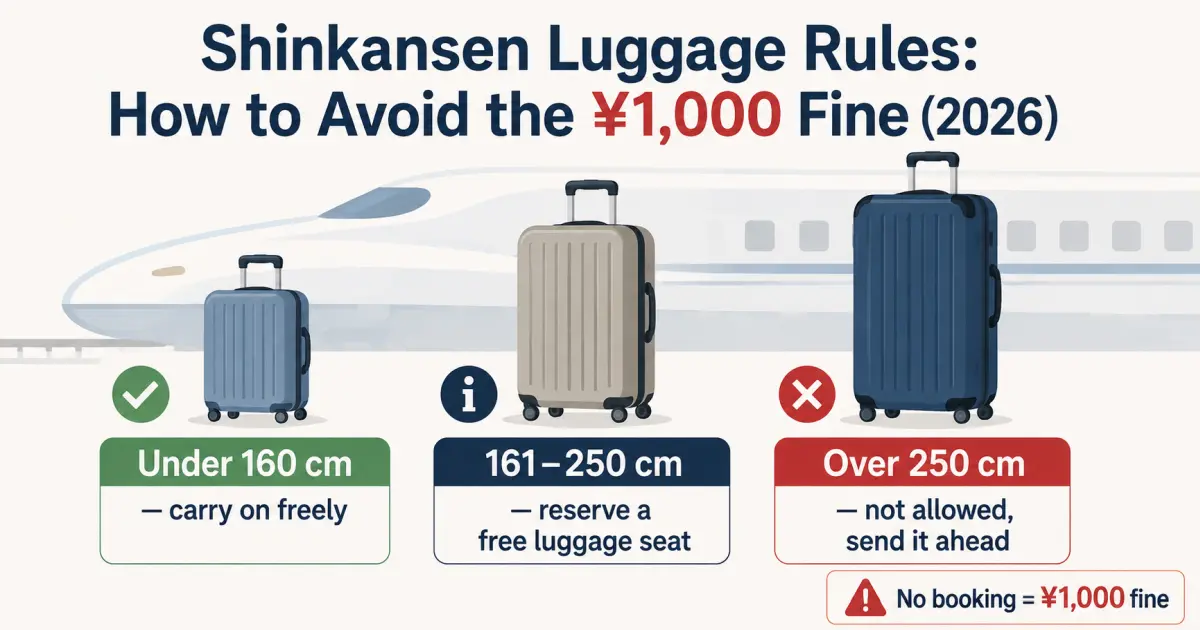
With a working Suica in hand, the hard part of arriving is over. Next comes actually getting where you are going — which trains to take, what the luggage rules are on the Shinkansen, and how to reach places beyond Tokyo.
IC card rules in Japan change often. This guide reflects the situation as of 2026 — for the latest status, check the official JR East site before you fly.
Part of: Japan, Made Simple
This guide is one piece of Japan, Made Simple — a local’s answers to the practical stuff no guidebook explains well, from payments and trains to onsen rules and hard-to-get tickets. Start there to find the next thing you need to sort out.