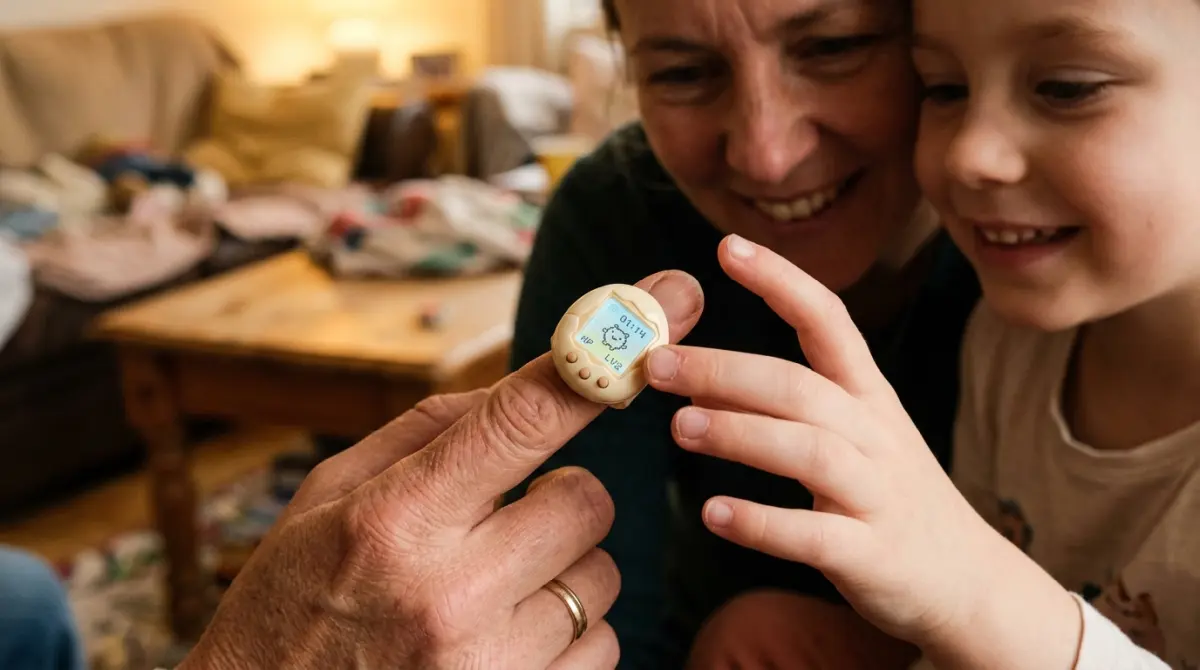
You glance at her hand and think: nice ring. Then it lights up. That little glowing thing on her finger isn’t jewelry at all. It’s a Tamagotchi.
On August 27, 2026, Bandai unveiled the “Tamagotchi ring” at the Tokyo Toy Show, and a model walked out with one on her finger like it was the most natural accessory in the world. It’s the first Tamagotchi you wear as a ring, and at 28mm it’s the smallest the company has ever made.
Which raises an honest question: why would anyone turn a 1990s toy into finger jewelry? The short news stories will tell you the price and the release date. This one is about what the ring is actually telling us about Japan.
First, what is the Tamagotchi ring?
The basics, quickly. It’s 28mm long, about 56% the size of the original 1996 model, yet it still packs a color LCD screen. It comes in three colors, each at 7,700 yen (tax included), and every version lets you raise 30 different Tamagotchi characters drawn from across the last 30 years. Depending on how you care for it, you can even grow a secret one.
Purchase details are further down, and there’s a catch worth knowing about if you’re reading this from outside Japan.
You probably remember these too
Here’s the thing English-speaking readers sometimes forget: Tamagotchi was never just a Japanese story.
When it launched in the late 90s, demand went global almost overnight. Shortages spread far beyond Japan, and Bandai ended up expanding sales into the US, Canada, the UK, and Australia to keep up. If you were a kid then, there’s a decent chance you (or the kid next to you in class) had one buzzing in a pocket, quietly starving because you weren’t allowed to check it during a lesson.
So the nostalgia the ring is reaching for isn’t only Japan’s. That shared memory is part of why a tiny glowing egg still works as a hook, thirty years on.
From pocket, to neck, to wrist, to finger
Look at where the Tamagotchi has lived over the years, and a pattern appears.
The original hung from a ball chain, clipped to a bag. Then came neck-strap versions you wore around your neck. In 2021, the wristwatch-style Tamagotchi Smart moved it onto your arm. And now, with the ring, it arrives on your finger.
Line those up and the direction is clear. The Tamagotchi has been steadily traveling from something you carry toward something you wear. What used to rattle around at the bottom of a backpack is inching closer and closer to your skin.
So why a ring? When kawaii meets fashion
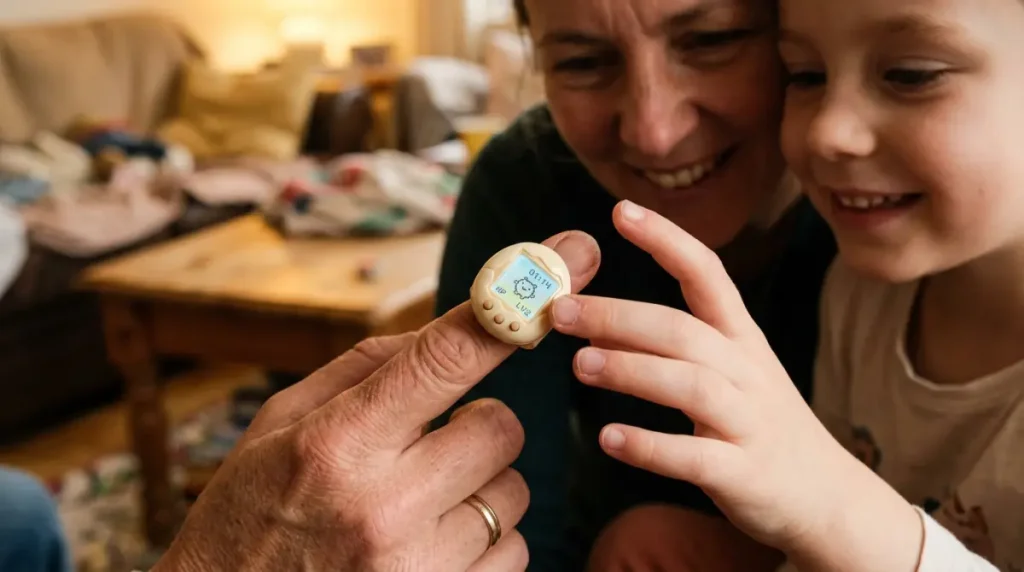
For the last few years, fashion has flirted with the “ring watch,” a timepiece worn on the finger as an accessory rather than a tool. The Tamagotchi ring sits comfortably in that same current.
And that tells you this isn’t really about shrinking a gadget. It’s about a change in what the gadget is. A device you once used to secretly do chores, feeding it, cleaning up after it, has become something you put on to be seen.
That flip matters. We used to hide our Tamagotchi under the desk, praying the teacher wouldn’t hear it beep. Now you wear it on your finger and, if anything, hold it up for a photo. Same toy, completely different role in daily life. “Something to hide” has become “something to show,” and the ring is the neatest possible expression of that.
What this actually says about Japan
Here’s where it gets more interesting than a product launch.
Caring for something small and fragile, feeding it, worrying when it’s sick, feeling that pang when it doesn’t make it, is a universal pull. Attachment isn’t a Japanese invention. But turning that feeling into a product, over and over, in fresh forms, for a new decade each time? That part Japan does with unusual fluency.
The current wave is often called Japan’s “third Tamagotchi boom,” running since around 2021. It’s powered by adults who grew up with the toy, by a younger generation meeting it for the first time as “Heisei retro,” and by people who simply like how it looks as an object. It has become less a toy and more an exportable piece of nostalgia, the same way city pop or old anime have found second lives abroad.
The ring, in that light, isn’t a gimmick. It’s Japan doing what it keeps doing: taking a small, emotional, slightly inconvenient ritual, caring for a pretend creature, and quietly redesigning it to fit the way we live now.
Can you actually get one?
Now the honest part.
The Tamagotchi ring is sold through Premium Bandai, Bandai’s own online shop, as a preorder that ships in February 2027. That means it’s built first and foremost for buyers in Japan. If you’re overseas, getting one isn’t impossible, but it usually involves overseas-shipping options or a proxy service, not a simple “add to cart.” So treat the link below as a reference point rather than a one-tap checkout.
- Sold by: Premium Bandai (BANDAI OFFICIAL TOY SHOP), direct
- Price: 7,700 yen (tax included), same for all three colors
- Preorder window: August 27, 2026, 10:00 to October 6, 2026, 23:00 (JST)
- Ships: February 2027
- Sizing: two Japanese ring sizes (10 and 14), with a spacer included
Official product page (Premium Bandai): https://p-bandai.jp/item/item-1000256484/
Details are as announced and may change. Check the official page for the latest information.
The bigger picture
Strip away the novelty and the ring is really a story about where this little device sits in our lives. From the bottom of a bag, to the neck, to the wrist, and now to the finger, it has spent 30 years quietly closing the distance. A 28mm ring is just the latest step.
If this kind of “why, not just what” look at Japan is your thing, we do a lot of it. See more in What’s Actually Trending in Japan — including why adults line up for capsule toys, why grown-ups carry plush companions everywhere they go, and how oshikatsu turns devotion into a lifestyle.