Here is the sentence that saves you money: bring a large suitcase onto the wrong bullet train without a reservation, and a conductor can charge you ¥1,000 on the spot. The reservation that avoids it is free. Most travelers simply never find out until it happens.
This guide walks you through the whole thing in the order that matters — measure your bag, check your line, book the right seat — plus one thing the other guides skip: how the passengers around you actually feel about that suitcase, and how to stay on their good side.
- The Short Answer: Measure Your Bag First
- The 160 cm Rule, and Why It Catches People Out
- It Depends on Your Line, Not Your City
- How to Reserve the Oversized-Baggage Seat (It’s Free)
- What Happens If You Don’t Book
- It’s Not Just the Fine — Winning Over the Passengers Around You
- The Smarter Option: Send Your Bag Ahead
- A Few Exceptions
- Quick Questions Before You Board
- Before You Board: The Four-Step Check
The Short Answer: Measure Your Bag First
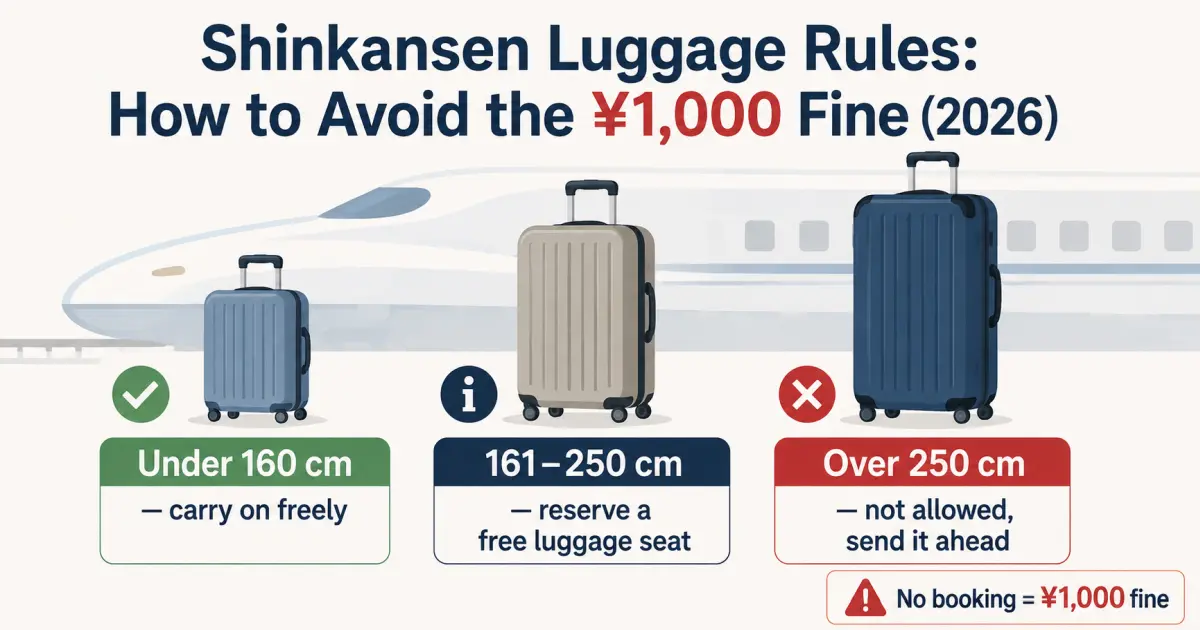
Everything starts with one number. Add the three sides of your suitcase together — height plus width plus depth, including the wheels and the handle. Do not eyeball it; get the total. That single figure tells you which of three situations you are in:
- 160 cm or under — carry it on freely. No booking, no fee.
- 161–250 cm — you need a free “oversized-baggage seat” on certain lines (details below).
- Over 250 cm — not allowed on the train at all. Send it ahead instead.
The 160 cm Rule, and Why It Catches People Out
Here is the trap. Most large check-in suitcases sold worldwide measure right around 157–158 cm total — deliberately, so they slide just under international airline limits. That also puts them just under the Shinkansen’s 160 cm line. But unzip the expander gusset to fit those last souvenirs, and you can quietly cross into “oversized” territory without noticing.
So measure the bag as packed, expander and all, with wheels and handle included. A suitcase that was fine on your flight into Japan is not automatically fine on the bullet train.
It Depends on Your Line, Not Your City
This is the part people get wrong: the reservation rule follows the line you ride, not the city where you bought the ticket.
Lines with the reservation rule
On the Tokaido, Sanyo, Kyushu, and Nishi-Kyushu Shinkansen, a bag totaling 161–250 cm needs a reserved oversized-baggage seat. In practice, that covers most trips out of Tokyo to the big destinations — Kyoto, Osaka, Hiroshima, Fukuoka, and Kagoshima all run on these lines. If your route is one of those, treat the luggage reservation as part of booking your seat.
Lines without it
The Tohoku, Hokkaido, Akita, Yamagata, Joetsu, and Hokuriku Shinkansen do not take luggage-space reservations. Storage there is first come, first served — so board early, and have a backup plan if the train is full.
How to Reserve the Oversized-Baggage Seat (It’s Free)
The most common misunderstanding: this is not an extra charge. You are simply choosing a normal reserved seat that happens to sit next to the luggage space — the gap behind the last row of the car, or a compartment near the deck. There is no added cost when you book it with your ticket.
The catch is supply. Each car has only about five of these seats, and on busy routes they go fast. Book as early as you can, whether online or at the ticket counter. On the N700-series trains that run the Tokaido line, these are usually around the back rows of each car.
What Happens If You Don’t Book
Board one of the reservation-required lines with an over-160 cm bag and no seat, and the conductor handles it on the spot:
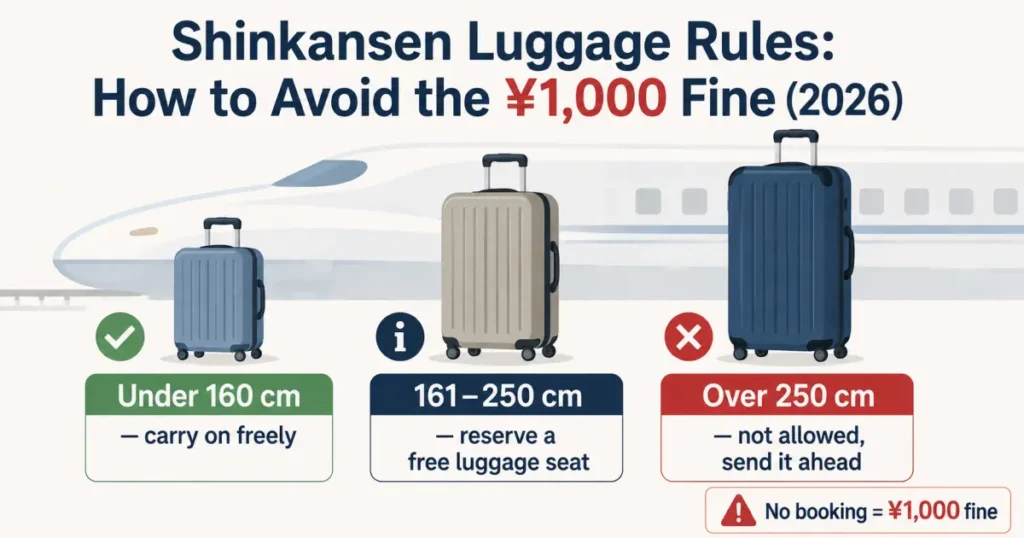
- A ¥1,000 handling fee, charged onboard, per oversized bag.
- Your bag gets moved to whatever space the staff can find.
- On a crowded train there may be no space at all — which means delay, stress, and a suitcase you can’t keep near you.
The asymmetry is the whole point: booking ahead is free, not booking risks ¥1,000 and a scramble. There is no upside to leaving it to chance.
It’s Not Just the Fine — Winning Over the Passengers Around You
The fee is the easy part to explain. The quieter thing worth knowing is how Japanese passengers feel about big luggage — because a little awareness here is what separates a tolerated tourist from a genuinely welcome one.
A 2025 survey by the Japan Private Railway Association (covering crowded commuter trains, not the Shinkansen specifically) is telling. Among complaints about foreign visitors, how luggage is carried and placed ranked second, at about 42%, behind only loud conversation. Roughly three in four respondents said they had, at some point, felt bothered by tourist behavior on trains.
Read that the right way, though. The same research points out that this is almost never about rudeness — it is about not knowing the unwritten rules of a very crowded space. What actually bothers Japanese passengers most is the occupation of shared space, and the sense that it’s being taken without a second thought. The fix is small and entirely within your control:
- Never block the aisle or the doorway. A suitcase left in a walkway is the single move that irritates people most. Keep it at your feet, tucked to the window side, or in a rack.
- Stand a bag upright in the overhead rack, not on its side — laid flat, it eats the space of the bag next to it.
- A small gesture goes a long way. Much of the friction comes not from the bag itself but from the absence of any “sorry, coming through.” A quick nod or a quiet sumimasen resets the whole interaction.
None of this is about tiptoeing around locals. It’s the same courtesy you’d want on a packed train back home — just aimed at the things this particular culture notices. Get it right and you’ll feel the difference: people relax around a traveler who’s clearly paying attention.
The Smarter Option: Send Your Bag Ahead
If your bag is over 250 cm, or you’d simply rather not wrestle it onto a crowded train, skip the whole problem: send it ahead. Japan’s luggage-forwarding services (takkyubin) pick up a bag at your hotel or a convenience store and deliver it to your next hotel, often by the next day.
You ride the Shinkansen with just a small day bag, no reservation to worry about, no aisle to block. For travelers hopping between cities, it’s the quiet upgrade that makes the whole trip easier — and it sidesteps every etiquette concern above at once.
A Few Exceptions
Some items are treated differently. Strollers, sports equipment (skis, snowboards, surfboards), and musical instruments generally don’t require an oversized-baggage reservation even if they’re large — though booking a nearby seat is still smart in busy seasons. Bicycles must be dismantled or folded into a proper bike bag. And the hard ceiling applies to everything: nothing over 250 cm total, over 2 m long, or over 30 kg comes aboard.
Quick Questions Before You Board
Does the oversized-baggage reservation cost extra?
No. Booked in advance with your ticket, it’s free — you’re just picking a seat next to the luggage space. The only cost is the ¥1,000 fee if you bring an over-160 cm bag without one.
How many bags can I bring?
Generally up to two pieces per person, each within 250 cm total, 2 m in length, and 30 kg.
What if the luggage space is already full?
On reservation-required lines, your booked seat guarantees the space. On other lines it’s first come, first served, so board early.
Do all bullet trains from Tokyo need a reservation?
No — it depends on the line. The Tokaido, Sanyo, and Kyushu Shinkansen require it; northern lines like the Tohoku and Hokuriku do not.
Before You Board: The Four-Step Check
Measure your bag, check your line, book the seat if you need it (or send the bag ahead), and keep the aisle clear. Do those four things and the luggage question is fully behind you — no fine, no scramble, and a carriage full of people quietly glad you thought about it.
Luggage rules and fees change, and some lines are trialing reservation-free compartments. This guide reflects the situation as of 2026 — check the official JR Central or JR West site before you travel, and book your oversized-baggage seat as early as you can.
Part of: Japan, Made Simple
This guide is one piece of Japan, Made Simple — a local’s answers to the practical stuff no guidebook explains well, from payments and trains to onsen rules and hard-to-get tickets. Start there to find the next thing you need to sort out.