If you have a tattoo, you’ve probably heard the warning: Japan’s hot springs may turn you away. It’s true in places — but it’s only half the story. There are onsen near Tokyo that welcome tattooed guests, and simple ways to soak even where the old rule still stands. The easiest way to move through all of it is to understand why the rule exists in the first place. It’s almost certainly not what you think.
First, Why Tattoos Get You Turned Away
This is the part worth reading slowly, because it changes how you’ll feel standing at a reception desk.
It’s not really about you
In Japan, tattoos (irezumi) have long been associated with organized crime — the yakuza, who wore elaborate full-body designs as a mark of belonging. So when an onsen posts a “no tattoos” sign, it is very rarely aimed at a foreign visitor with a small design on their shoulder. It’s a blunt, old tool for keeping a certain kind of trouble out of a quiet shared space. The rule is about avoiding discomfort among other bathers, not about judging you personally.
A stigma built up over centuries
The association didn’t appear overnight. In the Edo period, tattoos were used to mark criminals as punishment. In the Meiji era, decorative tattooing was banned outright as Japan reshaped its image for the world. Then, through the twentieth century, yakuza films cemented ink in the public mind as a symbol of the underworld. Three very different eras, stacked into one lingering impression — one that older generations still carry.
It’s also about “wa”
There’s a gentler layer underneath the history. An onsen is not just a bath; it’s a calm, almost purifying shared space, and Japanese social life places great weight on wa — group harmony. Anything that might make other guests uneasy tends to be avoided, quietly, for the sake of everyone’s comfort. Seen this way, the tattoo rule is less a moral judgment than an instinct to keep the water peaceful.
And it’s slowly changing
Attitudes are shifting. In 2020, Japan’s Supreme Court ruled that tattooing is not a medical act — a sign of how the legal ground has moved (tattoos were never illegal to begin with). Younger Japanese are far more relaxed about ink, tourism has pushed operators to reconsider, and the national tourism agency has openly asked onsen to be more accommodating to foreign visitors. The change is real, if uneven: it depends heavily on the region and the individual facility.
So Can You Still Enjoy an Onsen? Yes — Here’s How
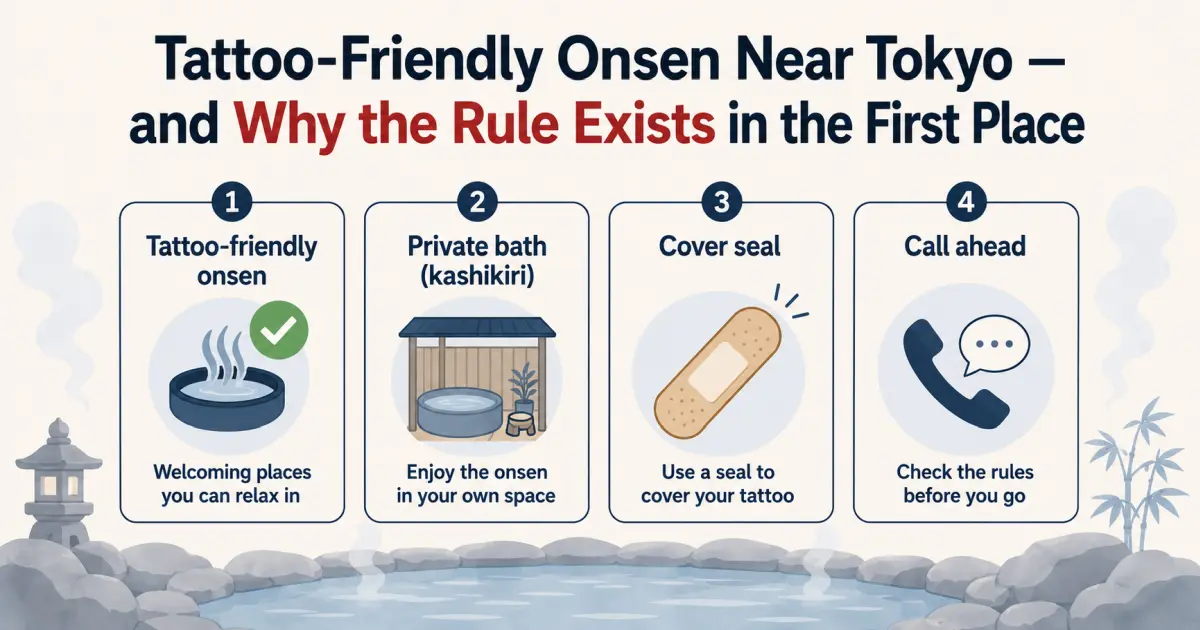
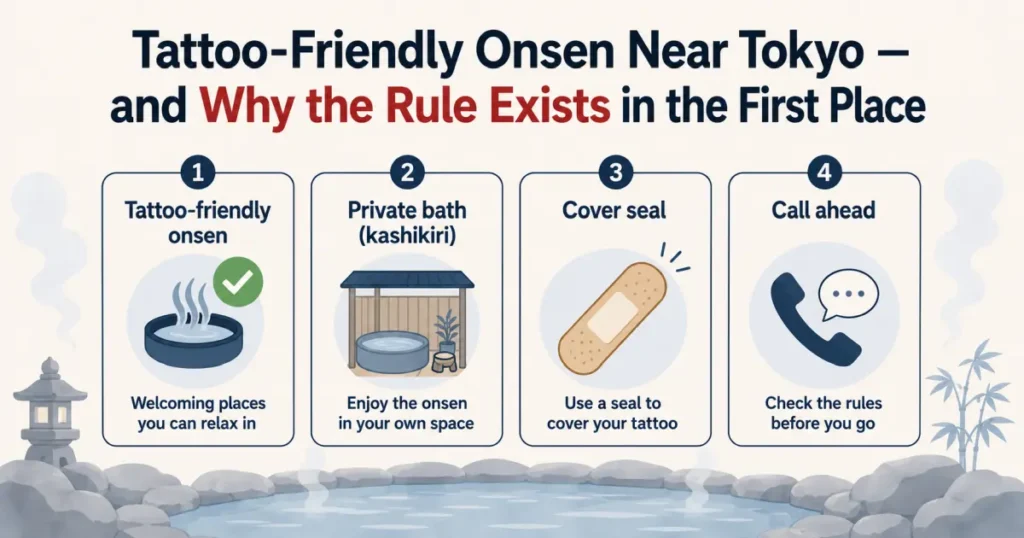
Absolutely. You have four reliable routes, and at least one of them will fit almost any trip.
1. Choose a tattoo-friendly onsen
The simplest option: go somewhere that already welcomes tattooed guests, so there’s nothing to cover and no conversation to have. A growing number of baths near Tokyo fall into this category (more on where to find them below).
2. Book a private bath (kashikiri-buro)
Many ryokan and day-use facilities offer private or family baths you can reserve by the hour. You bathe in complete privacy, tattoo or not, with no one else’s comfort to consider. This is the stress-free choice if your design is large or you’d simply rather not think about it.
3. Cover a small tattoo with a seal
If your tattoo is roughly postcard-sized or smaller, a skin-tone cover seal often does the trick. You can buy them at drugstores and at Don Quijote, and some onsen keep them at reception. Not a fix for full sleeves, but perfectly workable for something small.
4. When in doubt, call ahead
Policies vary facility by facility, and websites don’t always spell them out. A quick phone call or email before you go saves you an awkward moment at the door — and a wasted trip. When you can’t confirm, default to a private bath.
Where to Go Near Tokyo
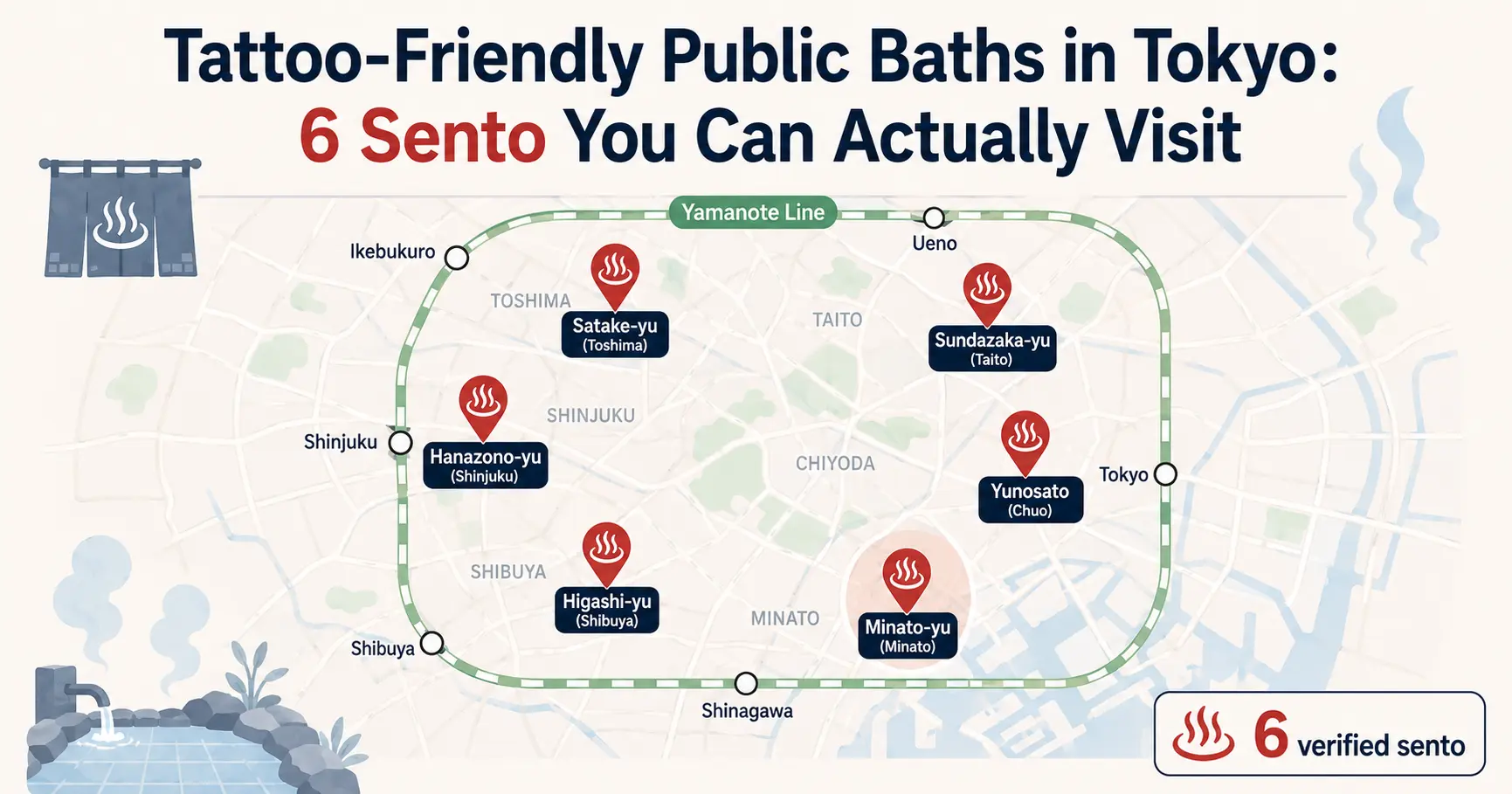
Options split into two kinds. Inside the city, neighborhood bathhouses (sento) let you fit a genuine soak into a sightseeing day — many sit a transfer or two from the Yamanote Line, and your IC card covers the whole trip. Further out, day-trip onsen towns trade convenience for scenery: open-air baths, mountain views, and a deeper sense of the tradition.
Because each facility sets its own policy and those policies change, we keep the specific venue recommendations — with current tattoo rules, access, and private-bath options — in a dedicated, regularly checked guide:
[ Read next: our verified list of tattoo-friendly onsen near Tokyo 👇]
Tattoo-Friendly Public Baths in Tokyo: 6 Sento You Can Actually Visit
Wherever you go, confirm the current policy with the facility itself before you set out. A rule that was relaxed last year can tighten again, and vice versa.
A Few Etiquette Notes So You’re Welcome Back
Getting in is only half of it — the other half is being the kind of guest a place is glad to see again. The basics travel well:
- Wash thoroughly before you enter the bath. The soak is for relaxing in clean water, not for cleaning yourself. Use the shower stations first.
- Keep your towel out of the water. Most people rest it on their head or set it at the edge.
- No phones, no photos. These are private, shared spaces — cameras are off-limits, full stop.
None of this is about performing for the locals. It’s the same quiet consideration you’d want from a stranger sharing any calm space — aimed at the things this particular setting cares about. Do it naturally and you’ll feel the room relax around you.
Quick Questions Before You Go
Are tattoos illegal in Japan?
No. Tattoos are legal, and a 2020 Supreme Court ruling confirmed that tattooing itself isn’t a medical act. But private facilities are free to set their own entry rules, which is why “no tattoos” signs still exist.
Where can I buy cover seals?
Drugstores, Don Quijote, and occasionally the onsen’s own reception desk. Look for skin-tone waterproof patches sized for small designs.
Will a small tattoo still get me turned away?
It depends entirely on the facility. Some ban all visible ink regardless of size; others are fine once it’s covered. When unsure, cover it or choose a private bath.
Do private baths need a reservation?
Usually yes, at both ryokan and day-use facilities. Booking ahead is the safe move, especially in busy seasons.
Soak Without the Stress
Understand why the rule exists, pick your route — a welcoming venue, a private bath, or a discreet cover seal — and confirm before you go. Do that and the tattoo question stops being a worry and goes back to being what it should be: a quiet, hot, deeply restorative soak.
Tattoo policies differ by facility and change over time. This guide reflects the general picture as of 2026 — always confirm the current rule with the specific onsen before your visit.
Part of: Japan, Made Simple
This guide is one piece of Japan, Made Simple — a local’s answers to the practical stuff no guidebook explains well, from payments and trains to onsen rules and hard-to-get tickets. Start there to find the next thing you need to sort out.