In our list of seven places that break the image of Osaka, this was number two, and it’s the one that quietly rearranges how you think about the city.
You already respect Osaka for its food — takoyaki, okonomiyaki, the whole “eat till you drop” reputation. What almost no visitor knows is that Osaka also handed the entire planet one of its most-eaten foods.
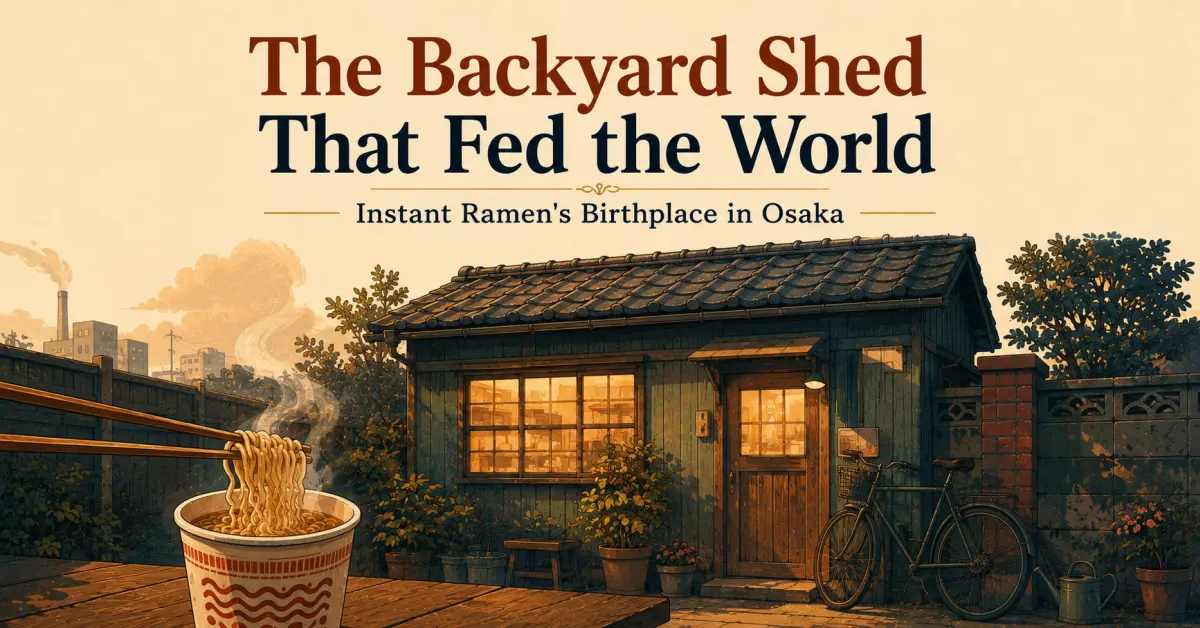
The instant noodles in your kitchen cupboard were invented in a garden shed in a quiet suburb north of the city, in 1958. And you can go stand in that shed.

One man, one shed, one year
The story is genuinely good, which is why the museum leans on it so hard. After the war, Osaka was hungry, and Momofuku Ando — a businessman who had already failed at several ventures — watched people queuing in the cold outside a black-market ramen stall near Umeda.
He became fixed on a single idea: a bowl of ramen anyone could make at home, cheaply, in minutes.
At forty-eight, with no staff and no outside money, he built a shed in the backyard of his house in Ikeda and worked in it for close to a year, sleeping only a few hours a night.
The problem that beat him for months was how to make a noodle that cooked instantly and kept for months. The breakthrough came from watching his wife make tempura: dropping the noodles into hot oil dried them out and left them full of tiny holes, so that later, hot water could flood back in and cook them in three minutes. He called the result Chicken Ramen. He was later inspired to invent Cup Noodle in 1971 — at sixty-one — after seeing Americans snap his ramen into paper cups and eat it with forks.
Today the world eats something on the order of 100 billion servings of instant noodles a year. All of it traces back to that shed.
What’s actually in the museum
The Cup Noodles Museum Osaka Ikeda opened in 1999 on the spot where it all began, and — this surprises people — admission is free.
📍 Cup Noodles Museum Osaka Ikeda (5 min from Ikeda Stn, Hankyu Takarazuka Line) — Google Maps
Inside there’s a faithful recreation of Ando’s backyard research shed, a display that walks through the invention step by step, a “Ramen Tunnel” wall lined with hundreds of instant-noodle packages from across the decades, and a theater built inside a giant Cup Noodle. You could see all of it in about ninety minutes.
But the reason to actually make the trip is that you don’t just look. You cook.
Make your own — two ways

My Cup Noodles Factory.
For around ¥500 you get an empty cup, decorate it however you like with markers, then choose your soup and your toppings — one broth from four, four ingredients from a dozen — so the cup you carry home is a combination no one else picked.
You watch your noodles get sealed in using Ando’s method, then it’s shrink-wrapped and yours. No reservation, but this is the catch: entry is by same-day numbered ticket, handed out first-come, and on busy days they run out. Come on a weekday, and come early.
Chicken Ramen Factory.
This is the serious one. You make Chicken Ramen from scratch — kneading the flour by hand, rolling it, steaming it, flavoring it, and flash-drying it, in about seventy minutes, wearing the bandana you get to keep. It costs ¥1,000 for junior-high age and up (¥600 for elementary school), runs a handful of times a day in small groups, and requires a reservation through the official site — book before you travel, because sessions fill.

Getting there and planning your visit
Ikeda Station on the Hankyu Takarazuka Line, about 25 minutes from Osaka-Umeda, then roughly a 5-minute walk. The museum is generally open 9:30–16:30 (last entry 15:30) and closed on Tuesdays — always check the official site before you go, and reserve the Chicken Ramen Factory in advance if you want it.
A couple of honest notes.
There are other Cup Noodles Museums — a bigger, glossier one in Yokohama and one in Hong Kong — but Ikeda is the birthplace, the actual ground where it was invented, and the only one with the shed. And while the museum is a favorite with families and a perfect rainy-day plan, adults tend to arrive skeptical and leave weirdly moved. It’s a museum about a dried noodle that turns out to be about not giving up at forty-eight.
The bigger Yokohama branch is worth a stop if you’re in Tokyo/Yokohama — but Ikeda is the actual birthplace.
📍 CUPNOODLES MUSEUM Yokohama (Minato Mirai) — Google Maps

Why it belongs on your Osaka list
Osaka’s reputation is built on eating. What’s easy to miss is the inventiveness underneath it — the merchant-city habit of looking at a problem sideways and solving it cheaply, whether that’s putting sushi on a conveyor belt or figuring out how to feed a hungry country three minutes at a time. Ando’s genius wasn’t really the noodle. It was the idea that anyone, anywhere, should be able to make a hot meal from a packet and a kettle. Standing in the little shed where he worked it out, that lands harder than you’d expect.
This is a closer look at stop #2 from Wait, That’s in Osaka? — 7 Places That Break the Image. More in the series: