You already have a picture of Osaka in your head. Neon smeared across a canal in Dotonbori. A giant mechanical crab. The smell of takoyaki.
Someone on a train platform loudly telling you their life story after thirty seconds.
All of it is true. Osaka wears its personality on the outside, and that’s a big reason it keeps landing near the top of foreign travelers’ wishlists — often named the third city they most want to see, after Tokyo and Kyoto.
But here’s what repeat visitors figure out. Osaka isn’t third because of its landmarks. Kyoto out-temples it. Tokyo out-scales it.
Osaka ranks that high because of two things no photo and no ranking can capture: the food, and the people. And once you’ve done the crab and the neon, the city quietly opens a second door.
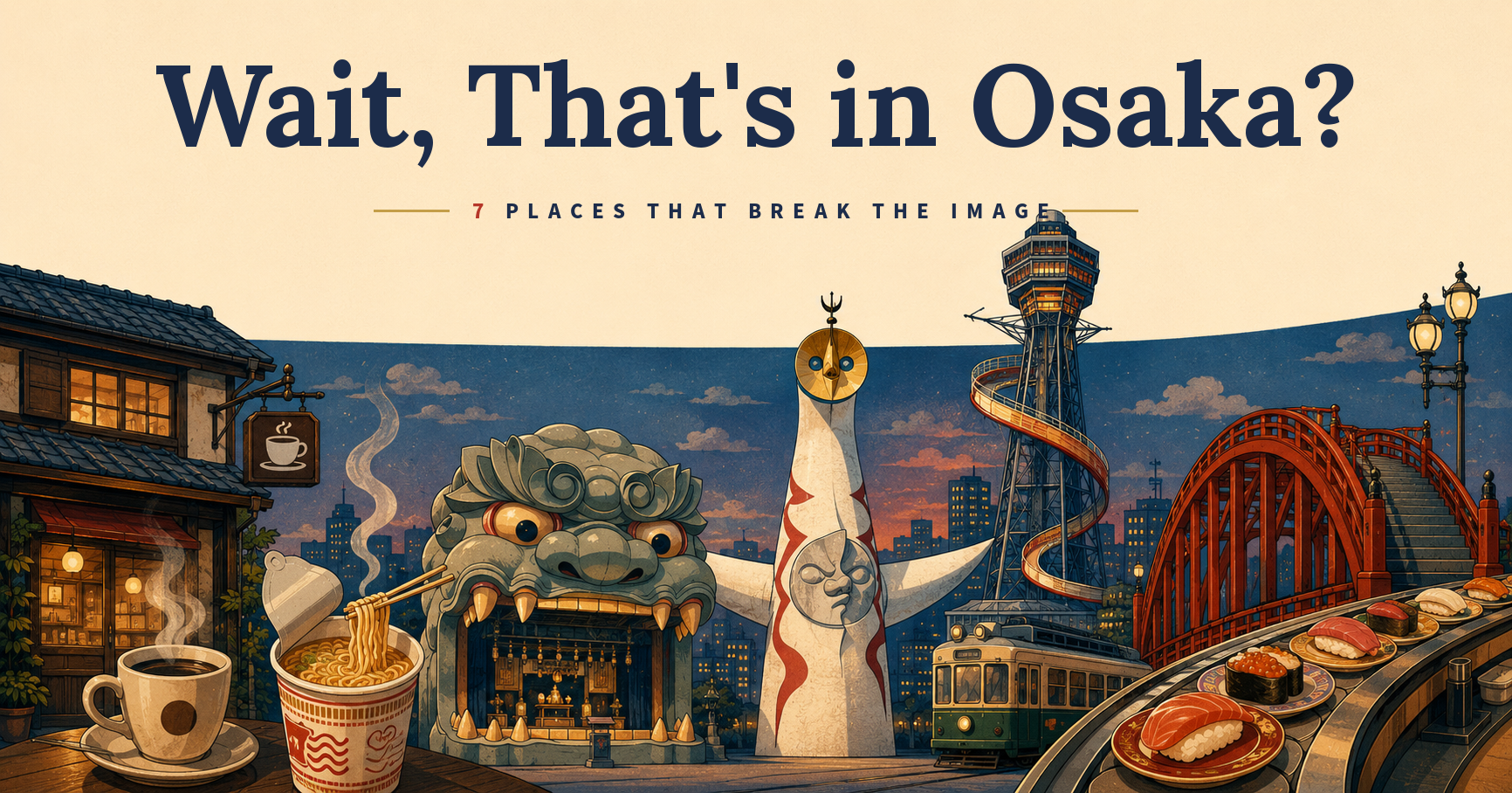
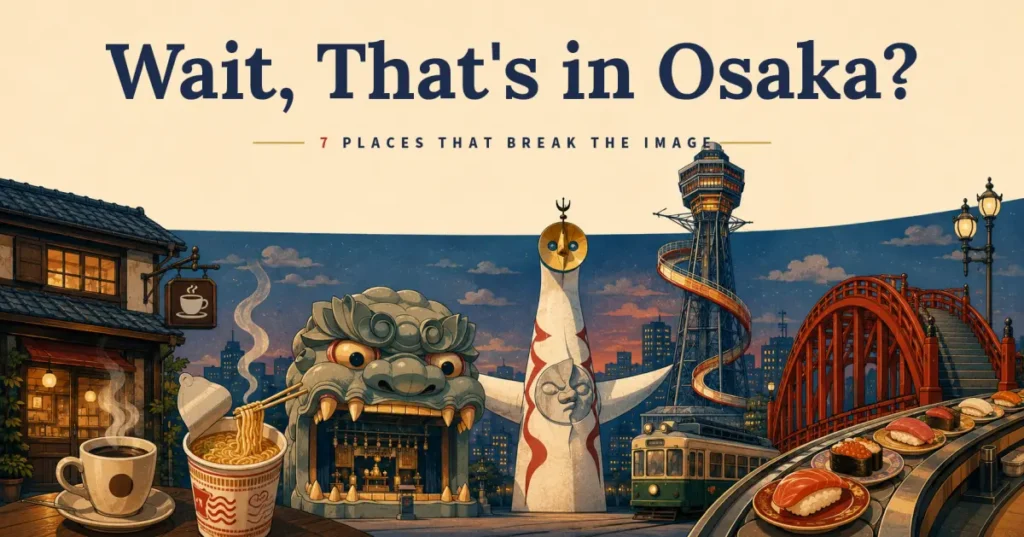
These are seven places that make even people who “know” Osaka stop and say — wait, that’s in Osaka?
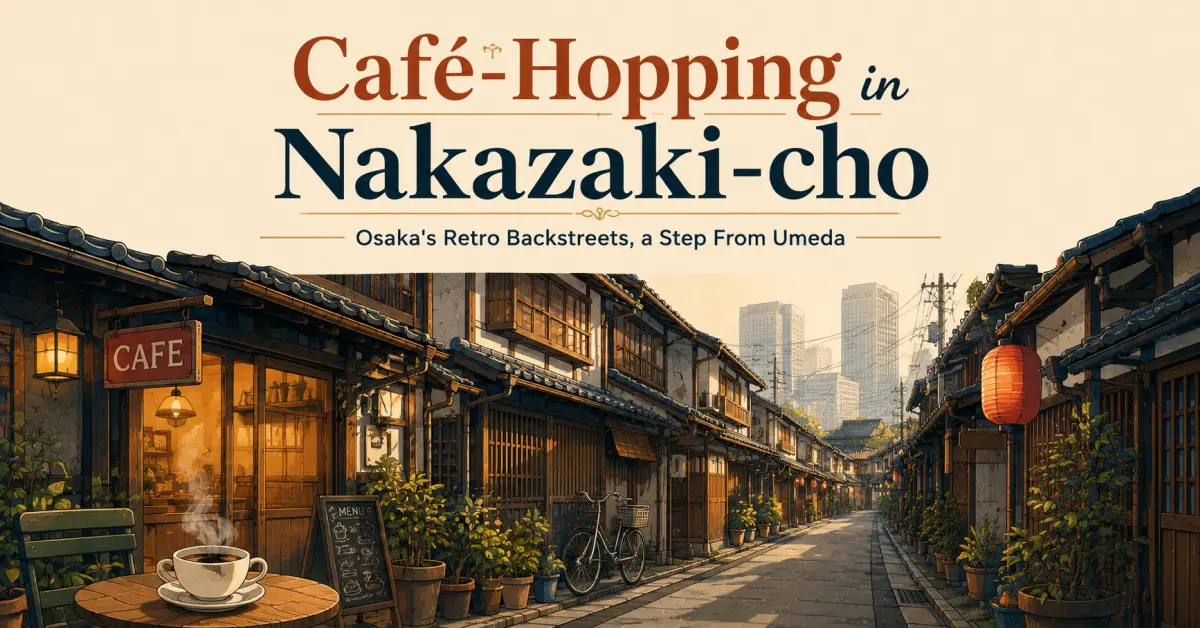
- 1. Nakazaki-cho — Vintage Cafés in the Shadow of Umeda
- 2. Ikeda — Where Instant Ramen Was Born
- 3. The Giant Lion That Swallows Bad Luck
- 4. Inside the Tower of the Sun
- 5. Tsutenkaku Has a 60-Meter Slide Now
- 6. Ancient Osaka and Its Last Tram
- 7. Where Conveyor-Belt Sushi Began
- The Osaka People Actually Want to Live In
- The Real Attraction Is the People
- The Real Attraction Is the People
- So — That’s Osaka Too
1. Nakazaki-cho — Vintage Cafés in the Shadow of Umeda
One stop from the skyscrapers of Umeda, the streets suddenly shrink. Nakazaki-cho is a pocket of old wooden row houses that escaped the wartime bombing that flattened most of the city, and over the past two decades they’ve filled up with tiny cafés, secondhand clothing shops, and one-room galleries.
Osaka rebuilt itself into steel and glass almost everywhere, so the few blocks the bombs missed feel like a held breath. No neon, no crowds shouting — just narrow lanes and coffee.
Getting there: Nakazaki-cho Station (Tanimachi Line), or a 10-minute walk north from Umeda. 🔗 [café-district guide — internal link]
2. Ikeda — Where Instant Ramen Was Born
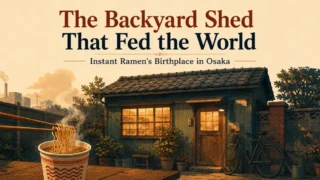
You already respect Osaka for okonomiyaki and takoyaki. What most visitors don’t know is that the city also handed the world instant ramen. In 1958, in a backyard shed in the suburb of Ikeda, Momofuku Ando fried the first packet of noodles that could survive a supermarket shelf.
It went on to feed the planet. At the Cup Noodles Museum in Ikeda you can design and make your own — a genuinely Osaka mix of invention and “let’s just try it and see.”
Getting there: Ikeda Station (Hankyu Takarazuka Line), about 25 minutes from Umeda. 🔗 [instant-ramen origin guide — internal link](Coming soon)
3. The Giant Lion That Swallows Bad Luck
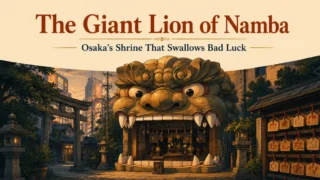
A few minutes’ walk from the chaos of Namba stands a shrine stage built in the shape of a lion’s head — roughly twelve meters tall, jaws wide open. Namba Yasaka Shrine’s Shishi-den is said to swallow evil spirits and swallow bad luck along with them.
It looks like something from a fever dream, it’s completely free to visit, and it’s sitting right next to one of the busiest districts you’ve already walked through without noticing.
Getting there: about 7 minutes on foot from Namba Station. 🔗 [hidden-shrines-of-Minami guide — internal link]👇
4. Inside the Tower of the Sun
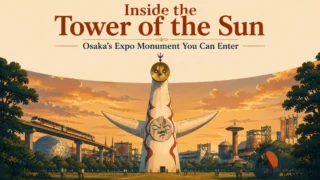
The Tower of the Sun is the surreal, three-faced monument that Tarō Okamoto built for Expo ’70. For almost fifty years, you could only stare at it from outside. Since 2018 you can go in — up through a 41-meter “Tree of Life” that traces the evolution of living things, restored to look exactly as it did during the Expo.
With Osaka hosting the World Expo again in 2025, standing inside the symbol of the last one hits differently.
Getting there: Expo ’70 Commemorative Park, Bampaku-kinen-koen Station (Osaka Monorail). Book the interior tour in advance — reservations are required, and same-day tickets only appear if there’s space.
🔗 Official site: Tower of the Sun (taiyounotou-expo70.jp) (English)
Related Article(Internal Site)👇
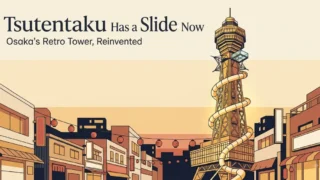
5. Tsutenkaku Has a 60-Meter Slide Now
Tsutenkaku is Osaka’s beloved retro tower — the golden Billiken god, the Showa-era glow, the postcard view of Shinsekai. So it surprises almost everyone that you can now drop straight down its side.
The TOWER SLIDER spirals 60 meters from the third floor to the basement, and one deck up, the see-through TIP THE TSUTENKAKU platform juts out into open air at 92 meters, with a glass floor under your feet. A century-old landmark quietly turned into a thrill ride.
Tsutenkaku Has a 60-Meter Slide Now
Getting there: Ebisucho Station (Sakaisuji Line), in the Shinsekai district.
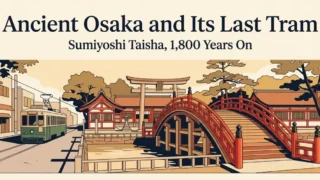
6. Ancient Osaka and Its Last Tram
Sumiyoshi Taisha has stood for over 1,800 years, in an architectural style so old it predates the arrival of continental influence in Japan.
Its steep vermilion drum bridge is one of the most photographed shapes in the city — and one of the least associated with “Osaka.” The best way to reach it doubles the surprise: the Hankai Tramway, the last surviving streetcar in Osaka, rattling one carriage at a time through quiet residential streets that feel a world away from Dotonbori.
Getting there: Hankai Tramway to Sumiyoshi-toriimae, or Sumiyoshitaisha Station (Nankai Line). 🔗 Ancient Osaka and Its Last Tram — Sumiyoshi Taisha
7. Where Conveyor-Belt Sushi Began
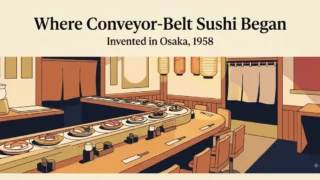
Every kaiten-zushi restaurant on Earth — every glowing chain, every touchscreen and every little plate rolling past on a belt — traces back to a single shop in Osaka.
In 1958, a sushi owner in Higashiosaka named Shiraishi Yoshiaki watched beer bottles ride a conveyor through a brewery and thought: why not sushi? He was short on staff and short on space, so he made the food come to the customer.
The original lineage, Genroku Sushi, still turns today. It’s not a museum. You just sit down and eat where the whole idea started — which is a very Osaka kind of monument.
Getting there: near Fuse Station (Kintetsu Line), east of central Osaka. 🔗Where Conveyor-Belt Sushi Began — Genroku Sushi, Osaka
The Osaka People Actually Want to Live In
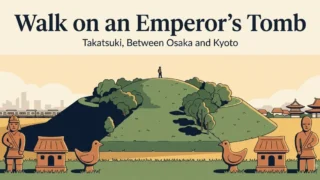
Visitors rank Osaka near the top of places to visit. But there’s a quieter ranking worth knowing: among Japanese residents deciding where to live, one Osaka suburb keeps climbing the list — Takatsuki, a town sitting almost exactly halfway between Osaka and Kyoto.
Why a commuter suburb beats out flashier addresses says a lot about what daily life in the Kansai region is actually like.
🔗 [Full Takatsuki article — internal link]
The Real Attraction Is the People
Here’s the part that no landmark can deliver. Osaka’s reputation for friendliness is not a tourism slogan — strangers will walk you to the station, shop owners will talk to you like they’ve known you for years, and the whole city runs on a warm, teasing, nandeyanen energy. The trick to enjoying it is simple: say yes to the conversation. A few words of the local dialect go an absurdly long way.
- “Meccha oishii!”
— “This is so good!” Say it to any food-stall owner and watch what happens. - “Ookini”
— “Thanks,” in the Osaka dialect. Locals light up when a visitor uses it. - “Nandeyanen!”
— a playful “you’ve gotta be kidding me!” It’s practically the city’s motto.
The Real Attraction Is the People
Every place on this list is worth seeing, but the thing visitors remember most about Osaka isn’t a place at all — it’s how the people talk to you. Osaka runs on a warm, teasing, fast-talking energy, and it has its own dialect, Osaka-ben, that even other Japanese find funny and disarming. The fastest way to make a shopkeeper light up is to throw a few words of it back at them.
Three to start with:
- “Meccha oishii!” — “This is so good!” Say it to any food-stall owner and watch what happens.
- “Ookini” — “Thanks,” in the Osaka way. Locals grin every time a visitor uses it.
- “Nandeyanen!” — a playful “you’ve gotta be kidding me!” — practically the city’s motto.
There’s a whole language of friendliness here, and it’s the most fun thing you can pack for Osaka. We put together a full beginner’s guide to speaking a little Osaka-ben — what to say, how to say it, and the reactions to expect.
👉 Read next: A Traveler’s Guide to Osaka-ben — Speak a Little Like a Local
So — That’s Osaka Too
Osaka is the crab and the neon. It’s also vintage cafés a step from the skyscrapers, a lion that eats bad luck, a monument you can climb inside, an 1,800-year-old shrine, and the birthplace of two foods you’ve already eaten a hundred times.
Third place was never really about the sights. Come for the food, stay for the people, and let the city surprise you twice.
Japan, Made Simple: The Practical Stuff No Guidebook Explains Well
More about Osaka You Don’t Know
How to Book the Pokémon Café in Japan: Tokyo & Osaka Reservation Guide (2026)
Nakazaki-cho cafes / Tower of the Sun inside / Tsutenkaku slide / conveyor belt sushi origin / instant ramen museum Ikeda / Sumiyoshi Taisha / Osaka off the beaten path