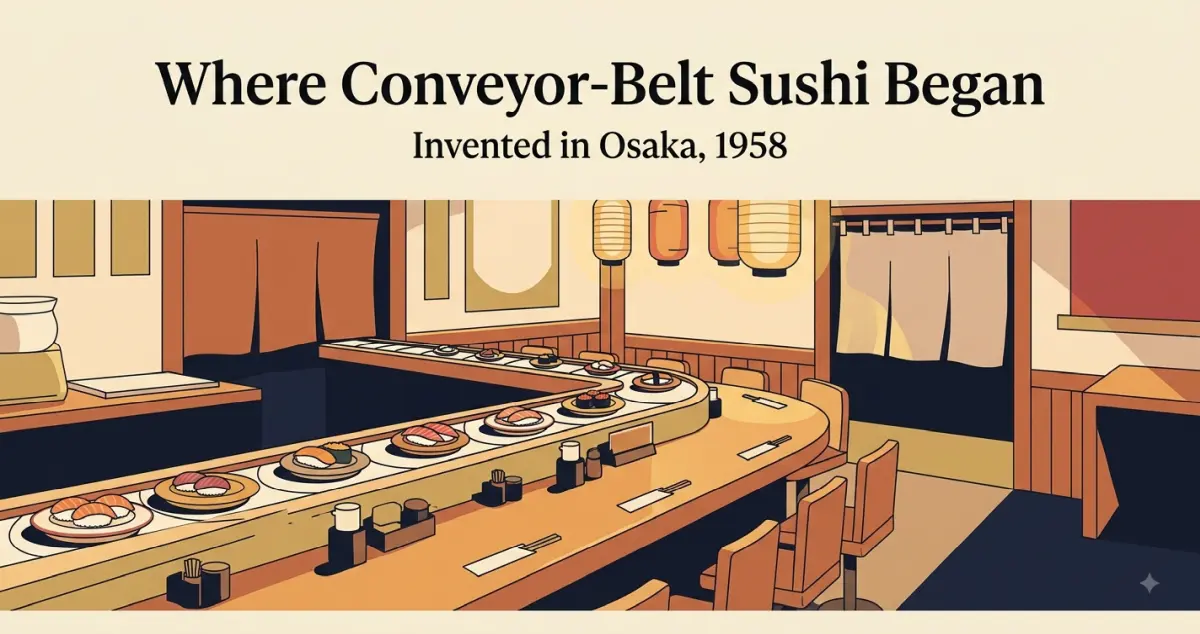
In our list of seven places that break the image of Osaka, this was number seven, and it’s the one that recolors every sushi meal you’ve ever had. Every kaiten-zushi restaurant on Earth — every glowing chain, every touchscreen order, every little plate rolling past on a belt — traces back to a single shop in Osaka. And unlike a museum, you can still just sit down at it and eat.
One owner, one brewery, one idea
In 1958, a sushi-shop owner named Yoshiaki Shiraishi had a problem that would sound familiar to anyone running a small kitchen: not enough hands, not enough space, and not enough time to serve every customer at the counter. The solution came from an unlikely place. Watching bottles glide along a conveyor belt inside a beer brewery, he wondered whether the food could move to the customer instead of the other way around.
He adapted a conveyor to carry plates of sushi past seated diners, opened the first kaiten-zushi in Higashiosaka, on Osaka’s east side, and called it Genroku Sushi. It was a very Osaka kind of invention — practical, a little cheeky, and aimed squarely at feeding more people for less. The idea spread across Japan, then the world.
Not a museum — a meal
This is what makes it worth a detour: Genroku Sushi still operates as a working restaurant, not an exhibit. There’s no ticket and no plaque to admire from behind a rope. You sit down, plates come around, you take what you want, and you eat where the entire global phenomenon started. For anyone who has spent an evening at a conveyor-belt chain back home, doing it at the source lands as something between a pilgrimage and a good, cheap lunch.
Getting there
Genroku Sushi’s roots are in the Fuse area of Higashiosaka, east of central Osaka (nearest access around Fuse Station on the Kintetsu line). Branches exist, so if you want the original lineage specifically, check the location before you go.
📍 Genroku Sushi, Fuse (Higashiosaka) — Google MapsWhy it belongs on your Osaka list
Osaka is famous for eating, but the deeper thread running through this whole list is inventiveness — the merchant-city instinct to look at an ordinary problem sideways and solve it cheaply. Instant ramen came from the same instinct; so did this. A hungry city with a talent for shortcuts gave the world a way to eat sushi that half the planet now takes for granted. Sitting at the counter where it began is the most delicious way to see the Osaka this series has been pointing at all along.
This is a closer look at stop #7 from Wait, That’s in Osaka? — 7 Places That Break the Image.
More in the series: instant ramen’s birthplace in Ikeda (the other great “invented in Osaka” story), Nakazaki-cho’s retro cafés, and the giant lion shrine of Namba.