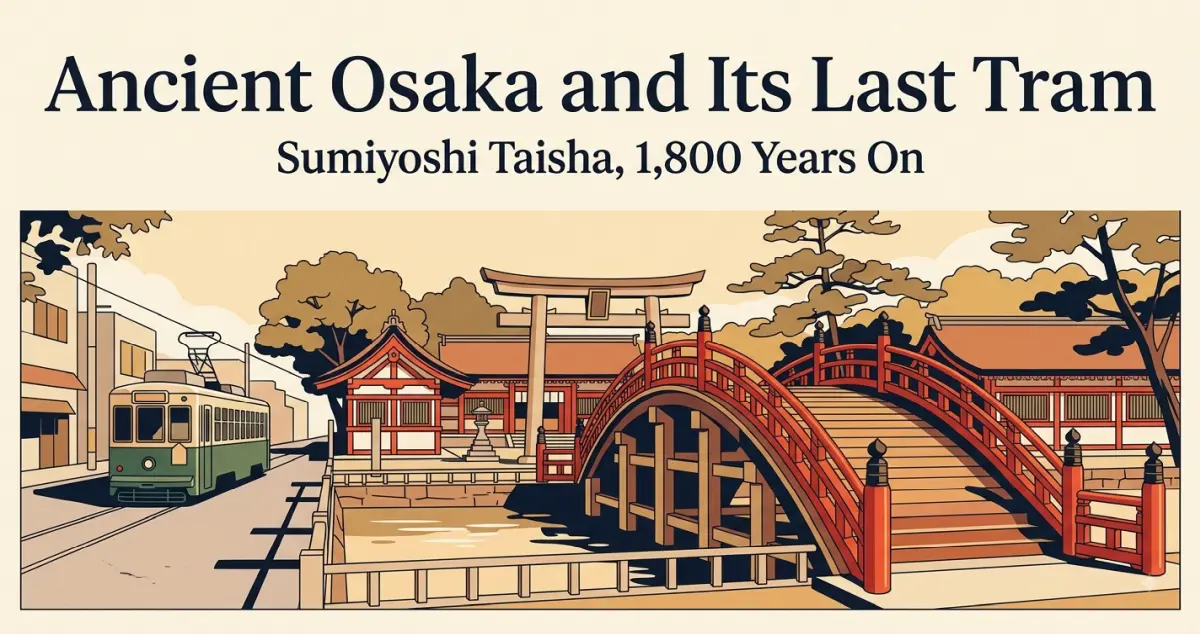
In our list of seven places that break the image of Osaka, this was number six, and it’s the one that feels like a different century. Say “Osaka” and people picture neon, noise, and crab signs. A short ride south of all that sits a shrine more than 1,800 years old, reached by the last streetcar left in the city. Nothing about it fits the postcard, and that’s exactly why it’s here.
A shrine older than the temples
Sumiyoshi Taisha is one of the oldest shrines in Japan — the head of some 2,300 Sumiyoshi shrines nationwide — and its main halls are built in a style called Sumiyoshi-zukuri, so old it predates the arrival of Buddhist and Chinese architectural influence. That’s the quiet remarkable thing about it: while most of Japan’s famous religious buildings show the curves and ornament that came over from the continent, these straight-roofed, vermilion-and-white halls preserve a purely native form. Four of them are National Treasures.
The shrine enshrines the three Sumiyoshi deities, gods of the sea and safe voyage, along with Empress Jingū. Sailors, and later merchants, have prayed here for safe passage and good fortune for well over a millennium, which is part of why it remains one of the most visited shrines in the country at New Year.
The bridge everyone photographs
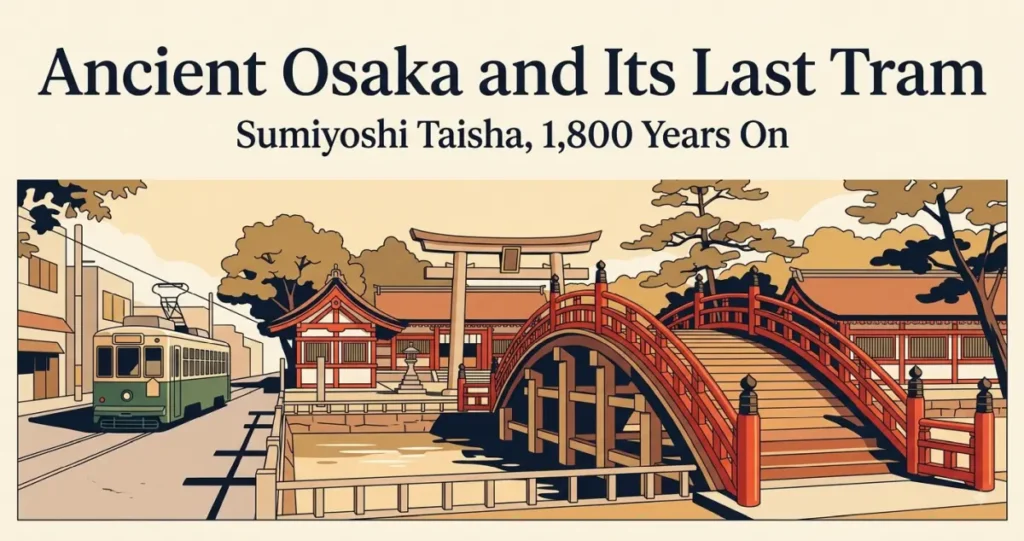
The image you’ll leave with is the Sorihashi, the steep vermilion drum bridge arching over the shrine pond. It’s much steeper than it looks — closer to a ladder than a footpath — and crossing it is traditionally a kind of purification, a shedding of the day before you reach the shrine. It’s one of the most recognizable shapes in Osaka, and one of the least associated with it.
Get there on the last tram
Here’s the detail that doubles the trip. The nicest way to reach Sumiyoshi Taisha is the Hankai Tramway — the only surviving streetcar line in Osaka. Single retro carriages rattle out of the city and down through old residential neighborhoods at a pace that has nothing to prove, and the Sumiyoshi-toriimae stop lets you off right at the shrine gate. After the density of central Osaka, the tram ride alone resets something.
Access: Hankai Tramway to Sumiyoshi-toriimae (right at the shrine), or Nankai Main Line to Sumiyoshitaisha Station. Free to visit; grounds open daily.
📍 Sumiyoshi Taisha (Hankai tram to Sumiyoshi-toriimae) — Google MapsWhy it belongs on your Osaka list
Osaka’s whole reputation is loud, modern, and now. Two of its quietest, oldest things — a shrine from before the temples and a streetcar the rest of the city retired decades ago — are sitting a short ride from the neon, still working exactly as they always have. That gap is the entire point of this series.
This is a closer look at stop #6 from Wait, That’s in Osaka? — 7 Places That Break the Image. More in the series: